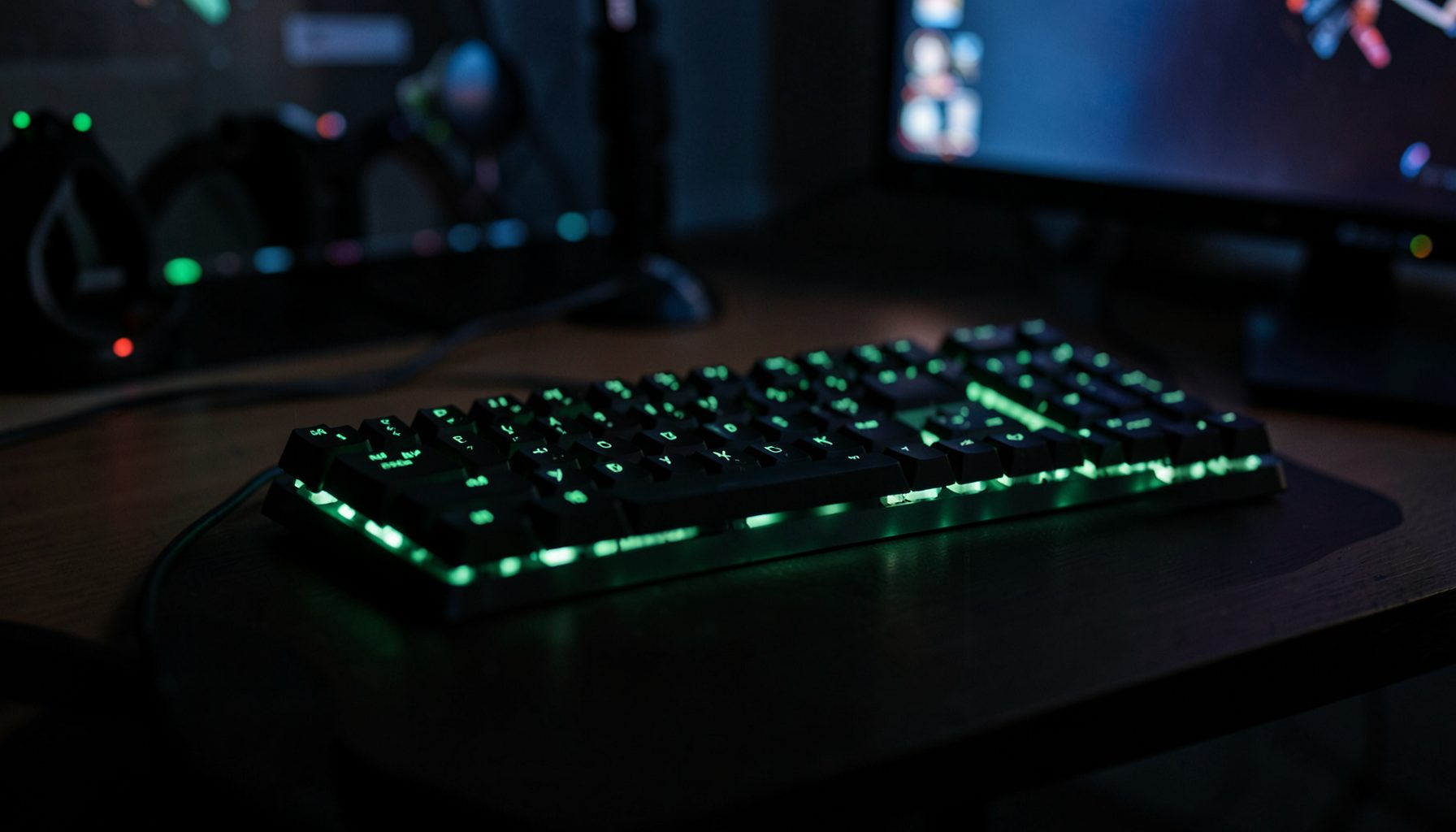
Building a $2,000 Gaming PC for 1440p High Refresh Rate
A $2,000 gaming PC sits in a productive middle ground. It can deliver excellent 1440p image quality, high frame rates in competitive games, and enough component headroom for demanding single-player releases without forcing every dollar into the graphics card. The challenge is balancing GPU performance with platform longevity, power delivery, storage, cooling, and a case that does not turn the system into a noisy oven.
For this budget, the graphics card remains the primary gaming investment, but the processor still matters when targeting 165Hz, 240Hz, or higher refresh rates. A fast eight-core CPU paired with modern memory can prevent frame-time spikes, while a quality power supply protects the entire build and leaves room for future upgrades.
Prices fluctuate by region, retailer, and promotion, so treat the figures below as planning targets rather than fixed rules. Keep a little flexibility for shipping and tax, and avoid suspiciously low listings. Price research can sometimes lead to unrelated specialist storefronts such as Trust Mash Oil, so verify that every checkout page, warranty, and seller is relevant to the component you intend to purchase.
Set The Right 1440p Performance Target
A high-refresh 1440p system should be designed around the games you actually play. Esports titles such as Counter-Strike 2, Valorant, Fortnite, and Overwatch 2 can reach well beyond 200 frames per second with a midrange or upper-midrange GPU. Newer cinematic games are a different test: ultra settings, ray tracing, and demanding upscaling can reduce performance considerably.
The sensible target is high settings at 1440p, with frame rates usually above 100 fps in demanding games and much higher in competitive software. A display with a 165Hz or 180Hz refresh rate pairs well with this goal. A 240Hz monitor makes sense for competitive players, but the CPU and memory configuration become more important because the GPU is no longer the only performance limit.
Upscaling technologies also influence the buying decision. DLSS on GeForce cards and FSR on Radeon cards can raise performance while preserving much of the native image quality. Frame generation is useful in supported single-player games, though it should not be treated as a substitute for strong native frame rates in latency-sensitive multiplayer titles.
Choose The GPU Before The Accessories
The GPU should receive roughly 35 to 45 percent of the total budget. Current high-value choices include the GeForce RTX 5070, RTX 5070 Ti, Radeon RX 9070, and Radeon RX 9070 XT, depending on local pricing. The RTX 5070 Ti is attractive for ray-traced games and DLSS users, while the RX 9070 XT often offers compelling traditional raster performance and a generous memory configuration.
Eight gigabytes of VRAM is increasingly restrictive for a premium 1440p build, particularly when high-resolution textures and ray tracing are enabled. A card with 12GB can work, but 16GB provides more comfort for current releases and future game patches. VRAM capacity is not a complete measure of performance, yet it has become an important part of the long-term value calculation.
The best GPU is the one that fits the rest of the system rather than the most expensive model that can be forced into the case. Spending too much on a flagship graphics card may require cutting the SSD, cooler, or power supply. Those compromises are difficult to notice on a specification sheet but can affect noise, loading times, upgrade flexibility, and reliability every day.
Match The CPU To The Frame Rate
AMD’s Ryzen 7 9800X3D is a standout choice for a premium gaming-focused build when its price is reasonable. Its large 3D V-Cache can help in CPU-limited games and high-refresh scenarios, especially when paired with a powerful GPU. The Ryzen 7 7800X3D remains a strong option if discounted, while the Ryzen 7 9700X offers a balanced mix of gaming and general desktop performance.
Intel’s Core Ultra desktop processors can also make sense for buyers who value productivity, video work, or platform-specific features. For a gaming-first system, however, the X3D options are often easier to recommend when the budget allows. A six-core chip can still run modern games well, but an eight-core processor gives a $2,000 build more breathing room for streaming, background applications, and future titles.
The AM5 platform is particularly appealing because it supports DDR5 memory and offers a clearer upgrade path than older sockets. A B650 or B850 motherboard with reliable power delivery, two or three M.2 slots, Wi-Fi if needed, and a modern rear I/O panel is generally enough. Avoid paying for extreme overclocking features that will never be used.
Compare Balanced Component Pairings
The following combinations show how the budget can be distributed. Actual totals depend on whether the build includes Windows, a monitor, peripherals, and assembly fees. They also exclude temporary retailer discounts, which can change the preferred pairing from week to week.
| Build focus | CPU | GPU | PSU target | Best suited to |
|---|---|---|---|---|
| Balanced ray tracing | Ryzen 7 9700X | GeForce RTX 5070 Ti 16GB | 850W Gold | DLSS, ray tracing, mixed games |
| Maximum raster value | Ryzen 7 7800X3D | Radeon RX 9070 XT 16GB | 850W Gold | High settings and strong native 1440p |
| High-refresh specialist | Ryzen 7 9800X3D | GeForce RTX 5070 or RTX 5070 Ti | 750W–850W Gold | Competitive games and CPU-limited titles |
| Upgrade-friendly platform | Ryzen 7 9700X | Radeon RX 9070 16GB | 850W Gold | Balanced gaming and general use |
The balanced ray-tracing configuration is the safest all-round recommendation for buyers who play a broad library. Nvidia’s software ecosystem, ray-tracing performance, encoder support, and upscaling can justify its premium. The maximum-raster option is compelling for players who prefer native rendering and want more VRAM without moving into flagship pricing.
The high-refresh build should be selected by players who spend most of their time in competitive games. In that environment, CPU cache, low memory latency, and consistent frame times matter as much as average GPU performance. A stronger processor can also improve one-percent lows, which are often more noticeable than a small difference in average fps.
Build Around Memory And Storage
For a modern 1440p gaming computer, 32GB of DDR5 is the practical baseline. A 2x16GB kit around DDR5-6000 with sensible timings is a strong match for Ryzen processors. Installing two matched modules is preferable to using four sticks, as the latter can make high memory speeds harder to achieve. Enable the motherboard’s EXPO or XMP profile after installation, then test system stability.
A 2TB NVMe SSD is a sensible target for a game library that includes large modern releases. A fast PCIe 4.0 drive offers excellent real-world loading performance without the price premium of the fastest PCIe 5.0 models. Spend more on capacity and sustained reliability before chasing benchmark numbers that rarely change game loading in a meaningful way.
Cooling also deserves a measured approach. A capable tower air cooler is enough for many Ryzen 7 chips and has fewer moving parts than a liquid cooler. A 240mm or 280mm all-in-one cooler can reduce temperatures under sustained workloads, but it should be chosen for case compatibility and pump warranty rather than appearance alone. Two front intake fans and one rear exhaust fan create a useful airflow foundation.
Select A PSU With Upgrade Headroom
Power supply selection becomes especially important when pairing a modern graphics card with transient power spikes. A quality 750W unit can support many RTX 5070 and RX 9070 configurations, while 850W is the more comfortable choice for an RTX 5070 Ti, RX 9070 XT, or a future high-end upgrade. Efficiency ratings matter, but internal platform quality, protections, warranty length, and connector design matter more than the badge alone.
Look for an ATX 3.0 or ATX 3.1 supply with a native 12V-2x6 cable where applicable. Native cabling is cleaner and reduces dependence on bulky adapters. Make sure the cable is fully inserted and does not bend sharply close to the connector. Buyers considering a more demanding Nvidia card should review this PSU connector guide before finalizing the wattage and cable layout.
A reliable 850W 80 Plus Gold unit from a reputable platform is usually a strong fit for this budget. Avoid treating wattage as the only specification: a cheap 1,000W supply can be a worse purchase than a well-built 850W model. Modular cables, quiet fan behavior, and a long warranty also improve the ownership experience.
Make The Budget Work Harder
The case should provide unrestricted front airflow, enough GPU clearance, and space behind the motherboard tray for cable management. Tempered glass and extensive RGB lighting are optional. A simpler mesh-front chassis can deliver lower temperatures and less noise for less money, freeing funds for the graphics card or SSD.
A reasonable allocation might put $700 to $900 into the GPU, $300 to $500 into the CPU and motherboard combination, $90 to $150 into memory, $100 to $160 into storage, and $100 to $160 into the PSU and cooling. The case can often be covered with $70 to $130. These ranges leave room for price variation while keeping the GPU as the performance priority.
Use these buying priorities when parts prices move:
- Protect the graphics card budget before paying for premium RGB, an oversized motherboard, or a flagship cooler.
- Choose 32GB of DDR5-6000 memory and confirm that the kit appears on the motherboard’s compatibility list when possible.
- Prefer a 2TB PCIe 4.0 NVMe SSD over a smaller drive with higher advertised sequential speeds.
- Buy an ATX 3.0 or ATX 3.1 Gold-rated PSU with the correct native GPU connector and sufficient reserve capacity.
- Check GPU length, thickness, cooler height, radiator support, and front-fan clearance before ordering the case.
Finalize The Build For Smooth Gaming
Once assembled, update the motherboard firmware if necessary, install the chipset and graphics drivers, and enable the memory profile. Set a sensible fan curve rather than allowing every fan to jump to maximum speed at minor temperature changes. Monitoring tools can confirm CPU temperature, GPU hotspot temperature, clock behavior, and power draw during a demanding game session.
Frame-rate limiting can improve consistency. Setting a cap slightly below the monitor’s maximum refresh rate often works well with adaptive sync, reducing unnecessary GPU load and keeping frame times steadier. In competitive games, experiment with the cap and graphics settings rather than assuming every option should be set to ultra.
For most buyers, the ideal $2,000 configuration is a Ryzen 7 9700X or 9800X3D, a 16GB RTX 5070 Ti or RX 9070 XT, 32GB of DDR5, a 2TB NVMe SSD, and a dependable 850W Gold power supply. That combination delivers the strongest mix of 1440p image quality, high-refresh responsiveness, and upgrade potential without wasting the budget on components that add little gaming performance.
Use the pairing that matches your game library, verify current prices, and build around the GPU, power supply, and airflow first. With those decisions made carefully, the rest of the system can be tuned for quiet operation and long-term reliability while the finished PC delivers the high-refresh 1440p experience the budget promises.