Building a gaming PC for sim racing
A sim racing PC has different priorities from a general-purpose gaming system. Racing simulators place sustained demands on the processor, graphics card, storage, cooling, and USB connectivity, while a triple-monitor cockpit adds a significant display workload. The right build should deliver stable frame times, clear peripheral support, and enough expansion capacity for future upgrades.
The main decisions begin with the screens and driving hardware rather than the case or processor. Three 1080p monitors are relatively easy to run, while a triple 1440p setup can push more than 11 million pixels every frame. Add high refresh rates, detailed track environments, force-feedback hardware, and extra accessories, and the power and connectivity requirements rise quickly.
A balanced system also needs to suit the simulator you play. Assetto Corsa Competizione, iRacing, Automobilista 2, rFactor 2, and Microsoft Flight Simulator can behave differently depending on resolution, graphics settings, AI opponents, and weather effects. Planning around your specific racing setup prevents expensive components from being wasted in areas that make little difference.
Start with the display target
Triple-monitor support should be defined before choosing a graphics card. Three 1080p displays at 5760 × 1080 are a sensible entry point for a broad field of view, especially when the monitors run at 60–144Hz. Triple 1440p at 7680 × 1440 provides a sharper image and suits larger 27- or 32-inch panels, but it requires considerably more rendering power.
Ultra-wide monitors can simplify the desk or cockpit, yet three separate displays offer greater flexibility. You can angle the side panels around the driver, replace one screen independently, and adjust each monitor’s position. A triple-screen arrangement also avoids some of the aspect-ratio limitations found in games that support ultra-wide resolutions inconsistently.
Check the graphics card’s physical outputs before buying. A typical modern card may provide three DisplayPort connections and one HDMI port, but exact layouts vary. DisplayPort is generally preferable for high-refresh 1440p monitors. Confirm that the card can drive all three panels at the desired resolution and refresh rate simultaneously, rather than supporting those specifications only on a single output.
Monitor bezels, alignment, and synchronization matter as much as resolution. Matching panels make color and motion appear more consistent, while adaptive-sync support can reduce tearing when frame rates fluctuate. A sturdy triple-monitor stand is essential because heavy 32-inch displays can place significant stress on desk mounts and cockpit frames.
Choose graphics hardware for three screens
The graphics card is usually the most important component for a triple-screen racing computer. At 5760 × 1080, a modern mid-range GPU can deliver strong results in many simulators. At 7680 × 1440, a higher-tier card with ample VRAM becomes more appropriate, particularly when using high texture quality, detailed shadows, long viewing distances, and large grids of cars.
VRAM capacity deserves careful attention. Racing games load high-resolution car textures, track assets, mirrors, and environmental effects into memory. A card with 12GB can be suitable for many 1440p configurations, but 16GB or more provides greater headroom for demanding titles, future updates, and triple-screen texture settings. Insufficient VRAM can cause stutter even when the average frame rate appears acceptable.
Upscaling technologies can help maintain smooth performance, but they should be treated as additional flexibility rather than a substitute for adequate hardware. Features such as DLSS, FSR, and XeSS may improve frame rates, although their image quality varies by game and implementation. Sim racers often value a clean view of braking markers and apexes, so test sharpening and motion behavior before relying heavily on an upscaler.
| Triple-screen target | Suitable graphics class | Typical VRAM preference | Best use case |
|---|---|---|---|
| 5760 × 1080 at 60–100Hz | Modern mid-range GPU | 8–12GB | Entry and value-focused cockpits |
| 5760 × 1080 at 144Hz | Upper mid-range GPU | 12GB or more | High-refresh competitive racing |
| 7680 × 1440 at 60–100Hz | High-end GPU | 16GB or more | Detailed triple-1440p setups |
| 7680 × 1440 at 144Hz | Enthusiast GPU | 16–24GB | Premium visuals and high refresh |
| Mixed or ultrawide expansion | GPU with strong display output support | 12GB or more | Flexible multi-display upgrades |
Frame-time consistency is more important than a peak benchmark result. A system that briefly reaches 160 frames per second but regularly drops into distracting stutters will feel worse than one holding a stable 100 or 120fps. Use an on-screen performance overlay to monitor one-percent lows, GPU utilization, CPU thread load, and VRAM usage while driving a full grid.
Match the wheelbase and racing peripherals
Wheel compatibility begins with the operating system and driver ecosystem. Most popular wheelbases connect through USB and require manufacturer software for firmware updates, force-feedback profiles, button mapping, and calibration. Before selecting a wheel, verify current Windows support and whether the brand’s control panel recognizes the wheelbase, pedals, shifter, and handbrake as separate devices.
Entry-level belt-driven and gear-driven wheels are generally straightforward to run on a gaming PC. Direct-drive wheelbases offer stronger, faster, and more detailed force feedback, but they can have higher peak power requirements and stricter mounting needs. A weak desk clamp or flexible cockpit can introduce movement that makes even an excellent wheel feel imprecise.
Pedals may connect through the wheelbase or directly to the PC. Direct USB pedals can be useful when mixing brands, although separate drivers and calibration utilities may complicate setup. Load-cell brake pedals benefit from a rigid pedal plate because braking force depends on pressure rather than travel. Check the available USB ports before adding a shifter, handbrake, button box, dashboard display, and head-tracking camera.
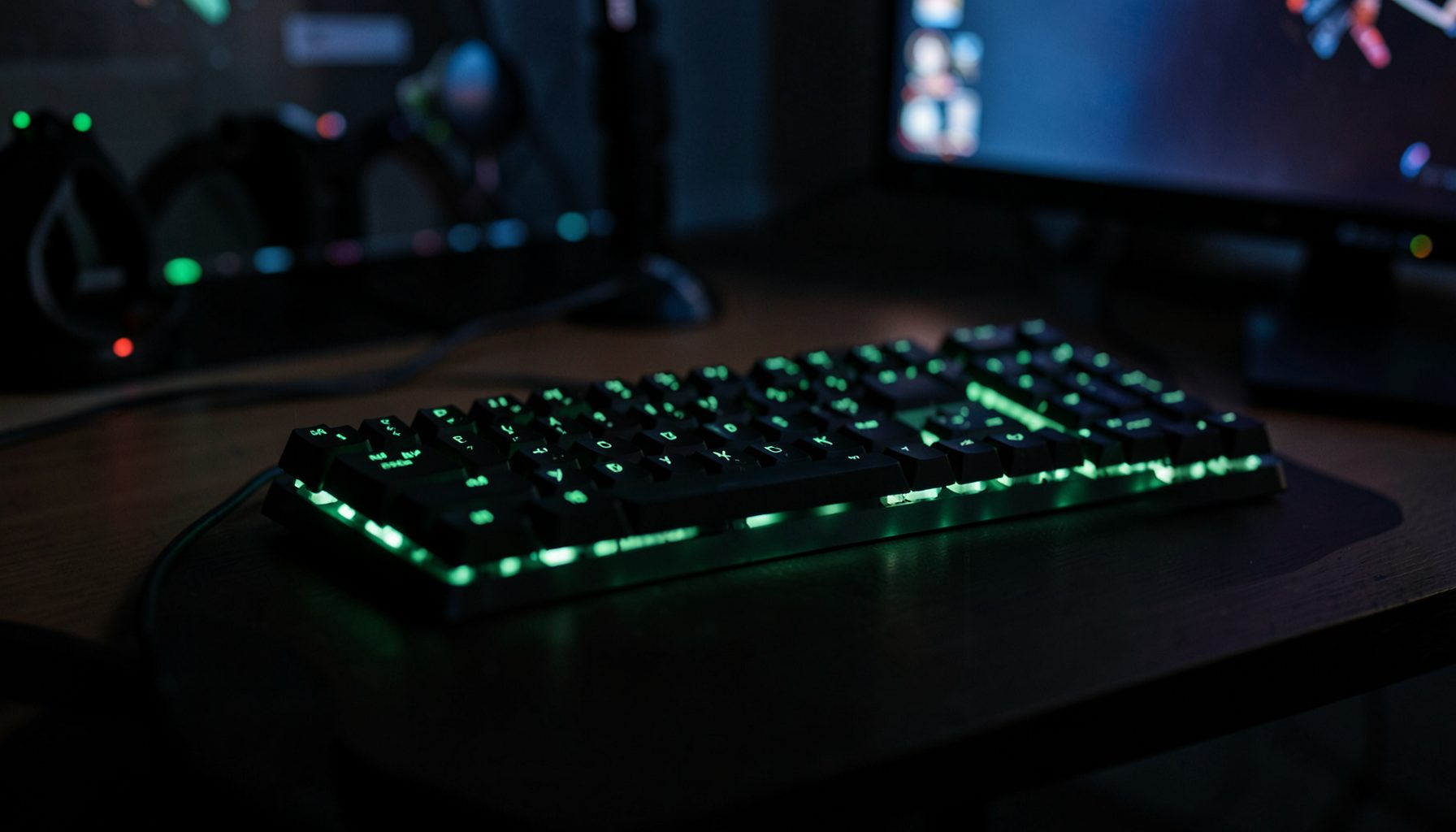
Peripheral comfort extends beyond the driving hardware. A compact mechanical gaming keyboard can fit beside a cockpit without taking over valuable space, while a reliable wireless mouse makes menu navigation easier. USB extension cables should be high quality and routed away from power cables where possible. Powered hubs can help with multiple low-power accessories, but essential devices should connect directly to motherboard ports when reliability is critical.
Size the power supply correctly
Triple monitors increase the total electrical load, but they usually connect to wall power rather than drawing energy from the PC’s PSU. The power supply still needs to handle the graphics card, processor, storage, cooling fans, USB devices, and transient spikes. A high-end GPU can briefly demand more power than its advertised gaming average, so selecting a unit close to the calculated total is risky.
For a mid-range graphics card and mainstream processor, a quality 650–750W unit may be sufficient. A powerful GPU paired with a high-performance CPU generally deserves an 850W model, while enthusiast graphics hardware or future upgrades can justify 1000W or more. These figures are starting points, not universal rules; the exact recommendation depends on the GPU model, processor power limits, and the number of drives and accessories installed.
Look for an ATX 3.0 or ATX 3.1 power supply when using a recent graphics card. Native modern GPU connectors can reduce adapter clutter and help ensure the cable is seated correctly. Use separate PCIe cables where the manufacturer recommends them, avoid sharp bends near a new high-current connector, and keep cables clear of the graphics card fans.
Efficiency certification is useful, but it does not automatically indicate build quality. A reputable unit with strong independent testing, a long warranty, stable voltage regulation, and suitable protections is a safer choice than an inexpensive model with a higher efficiency badge. Modular cabling also improves airflow and makes it easier to install only the connections required by the cockpit PC.
Build around stable frame times
The processor remains important because many racing simulators calculate physics, opponent behavior, tire models, and simulation updates on the CPU. A current six-core or eight-core processor can handle a broad range of games, but a high-end chip with strong single-thread performance is valuable for large multiplayer grids and complex AI sessions. Processor cache can also benefit some simulation workloads, although results vary by title.
A sensible baseline is 32GB of system memory using a matched dual-channel kit. Choose 64GB if you run a simulator beside streaming software, telemetry tools, browser windows, recording applications, or mod managers. Memory speed and motherboard compatibility should follow the platform’s recommended specifications rather than chasing unstable overclocks.
Fast NVMe storage improves boot and loading times, especially when a simulator library contains large track and car collections. A 1TB drive can work for a focused installation, but 2TB provides more room for several games, mods, replay files, and future updates. Keep at least some free capacity available because nearly full SSDs can complicate maintenance and reduce sustained performance.
Cooling needs to match continuous racing sessions. A capable tower air cooler is enough for many processors, while a larger dual-tower cooler or all-in-one liquid cooler may suit high-power chips. Use a case with unrestricted front or side intake, exhaust fans near the CPU area, and enough clearance for a long, thick graphics card. Stable temperatures help prevent clock-speed fluctuations during extended races.
Plan the cockpit around the computer
A PC can meet every performance target and still feel poor in use if the cockpit layout is an afterthought. Measure the distance between the driver and monitors, the height of the wheel rim, and the room needed for pedal travel before buying display stands or a chassis. Triple screens should surround the driver’s sightline without forcing excessive head movement between the center and side panels.
Cable management has practical value in a racing rig. USB, DisplayPort, Ethernet, and power leads should be secured to the frame with enough slack for wheel and seat adjustment. Keep signal cables away from moving pedal mechanisms and ensure the emergency power switch or wall outlet remains accessible. Labeling each cable makes troubleshooting much easier after a firmware update or component change.
Network stability is also relevant for competitive racing. Wired Ethernet is preferable for online events because it reduces latency variation and wireless interference. If the PC must use Wi-Fi, position the antenna away from the metal cockpit frame and use a modern router with strong coverage. A stable connection cannot correct a poorly optimized game, but it removes one avoidable source of inconsistency.
Before final assembly, check motherboard expansion slots, GPU thickness, cooler clearance, PSU length, and the number of rear USB ports. This is especially important when the build includes capture hardware, a sound interface, motion equipment, or a dedicated telemetry display. Leaving one or two expansion paths available makes the system easier to upgrade than a tightly packed build with no spare capacity.
Use this buying checklist
The following priorities keep the budget focused on the parts that influence the racing experience most:
- Choose the graphics card from the intended triple-screen resolution and refresh rate, with enough VRAM for high texture settings.
- Select a processor with strong gaming performance and sufficient cores for AI grids, telemetry, streaming, and background applications.
- Confirm wheelbase, pedal, shifter, and handbrake drivers before mixing brands or relying on multiple direct USB connections.
- Buy a reputable ATX 3.0 or ATX 3.1 PSU with adequate overhead for transient spikes and future graphics card upgrades.
- Reserve space and connectivity for the cockpit itself, including a rigid wheel mount, suitable pedal plate, monitor stand, and powered accessories.
A balanced build usually produces better results than spending the entire budget on the graphics card. If the display target is triple 1080p, money may be better allocated to a stronger wheelbase, load-cell pedals, a sturdy cockpit, or higher-refresh monitors. If triple 1440p is the priority, the GPU and PSU deserve more of the budget while the processor should still be capable of maintaining consistent simulation updates.
Test the complete setup with the simulator you actually play. Begin with moderate graphics settings, verify all three screens are detected correctly, calibrate steering and pedal ranges, and monitor temperatures and frame-time behavior during a long session. Then increase visual quality gradually, keeping the settings that improve immersion without creating distracting stutter.
Build around the monitors, wheelbase, and games rather than a parts list assembled in isolation. With compatible displays, a graphics card matched to the pixel load, reliable USB support, and a properly sized PSU, your sim racing PC can deliver a stable foundation for sharper visuals, stronger force feedback, and future cockpit upgrades. Start by measuring the rig and defining the target resolution, then choose each component to support that driving experience.