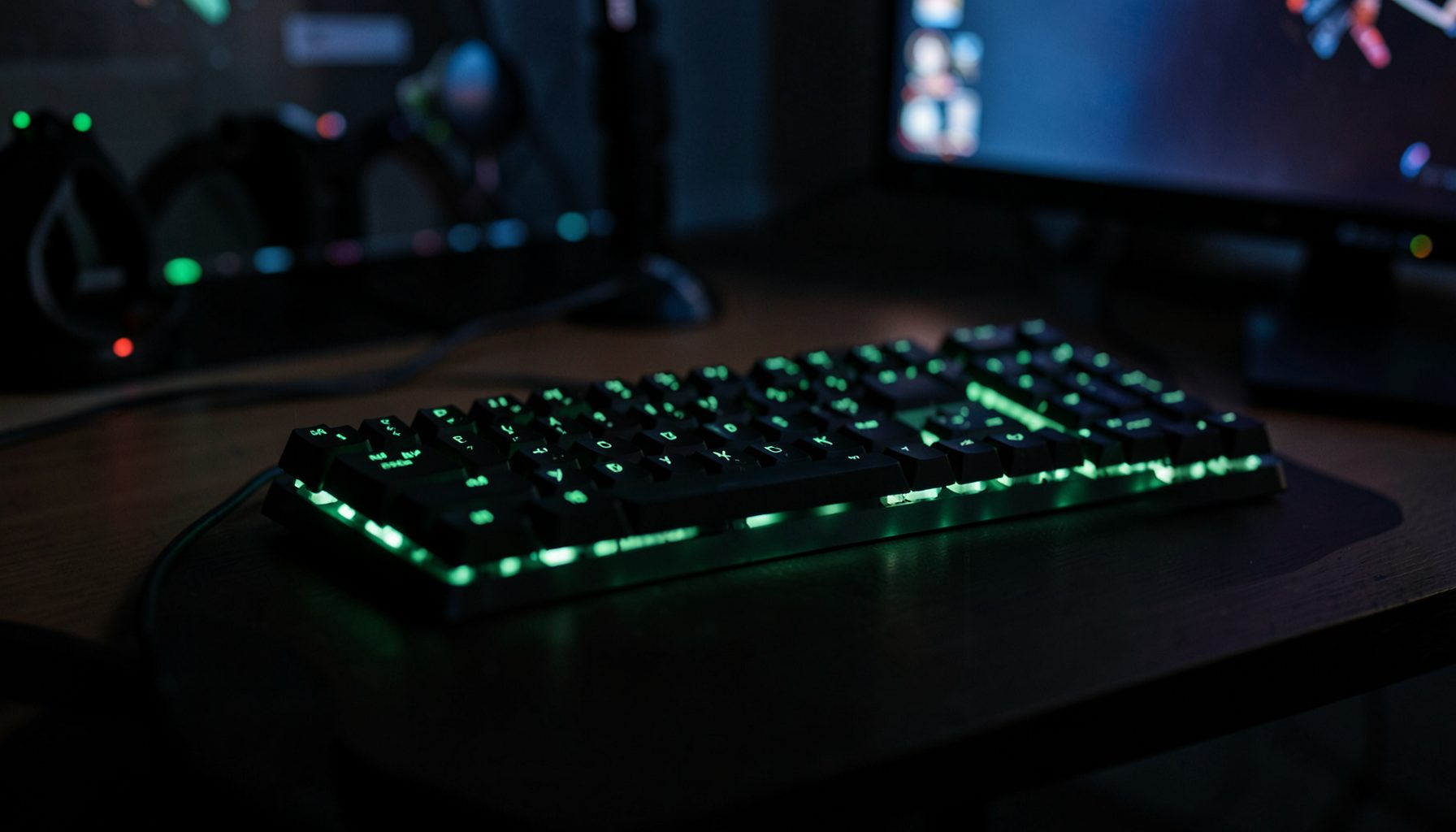
Corsair K100 Air Wireless Review: A Featherweight Contender for Australian PC Builds
The Corsair K100 Air Wireless lands in a crowded mechanical keyboard market with one very clear mission: strip away every unnecessary millimetre of bulk without sacrificing the typing feel and wireless reliability that competitive gamers demand. Sitting at roughly 17mm tall at the front edge, this is one of the slimmest mechanical boards Corsair has ever shipped, and it carries the flagship K100 branding into a form factor that finally fits beside a monitor arm or a stack of books on a small Melbourne apartment desk. It pairs the distinctive Cherry MX Ultra Low Profile switches with the established SLIPSTREAM wireless ecosystem, promising sub-1ms latency for competitive play and Bluetooth for hooking up to a laptop on the train from Parramatta into Central.
For Australian buyers weighing up the typical $349 to $399 AUD price tags seen at retailers like JB Hi-Fi, Mwave, PLE Computers and Umart, the K100 Air Wireless arrives as a premium alternative to the chunky mechanical flagships that have dominated the past five years. The idea is straightforward: give streamers, competitive Valorant players and code-cutters a board that disappears visually, runs on a single USB-C cable when needed, and still ticks off per-key RGB, media controls and macro depth that the iCUE crowd expects. Across the next sections we break down how that promise translates into daily use, from an unboxing experience on a Brisbane gaming-café counter to a full Friday-night LAN session in a Sydney share house.
The board slots into a market segment that has been heating up locally since the launch of Keychron and NuPhy low-profile options in 2021. Corsair's play here is different, leaning into the enthusiast audience who already own Corsair mice, headsets, and power supplies and want one ecosystem under iCUE. That ecosystem tie-in, alongside genuine mechanical travel, is the headline feature. Whether it is enough to justify a premium spend for Australians who might otherwise pick a Logitech G Pro X 60 or a Razer Huntsman Mini depends on a few specific performance details.
Ultra-Thin Chassis and Daily Handling
The first thing you notice sliding the K100 Air Wireless out of its packaging is how light it feels — around 880 grams without the cable, several hundred grams lighter than a standard full-size K100. The chassis combines a brushed aluminium top plate with a polycarbonate base, and Corsair has shaved height by routing the battery, wireless PCB, and switches into a single thin stack. The result is a board that barely lifts a desk mat and slings easily into a backpack for weekend LAN trips out to regional towns for friends' birthday tournaments.
In everyday use the board sits flat without the usual front lip that catches on shirt cuffs during long typing sessions. Australian reviewers who game late into the night in studio apartments appreciate the lack of a wasted footprint, especially when desks double as kitchen tables in share houses. The included wrist rest is slim and magnetically detachable, and the USB-C port is centred along the back edge, which keeps cable runs clean when routing through grommets in a standing desk setup.
There is a small drawback for buyers who like industrial design accents. The chassis lacks the chunky side bevels of the original K100, which means the magnetic palm rest looks slightly disconnected visually. Still, the construction feels solid, with no audible pinging during heavy-handed WASD play, and the included braided USB-C cable is long enough to reach a tower tucked under a desk in a Perth gaming nook. The board ships in black and a soft white finish, with the latter showing fewer fingerprints during long humid summer days in northern Queensland.
Cherry MX Ultra Low Profile Switches Under the Keys
The mechanical heart of the K100 Air Wireless is the Cherry MX Ultra Low Profile switch, originally developed in cooperation with Corsair and now in its second major revision. These linear switches offer a total travel of just 1.8mm with an actuation point at 1.0mm and an actuation force of 45 grams. For anyone coming from a Cherry MX Red or Speed Silver board the difference is immediately felt — keys fire with a touch less resistance, and travel is so short that competitive FPS players need to recalibrate muscle memory slightly to avoid misfires.
The typing experience is more divisive. For fast-paced gaming it feels precise, almost like a laptop keyboard that finally grew up. For long-form writing or coding marathons it can feel a touch shallow, especially if you tend to bottom-out your keys. The pre-lubed stabilisers do a respectable job on the space bar, enter, and left shift, although there is a slight rattle on the right shift that tinkerers in Sydney's Enmore PC-building community have noted in teardown videos. Keycap compatibility is the usual low-profile caveat: only taller Cherry MX Ultra Low Profile stems will fit, so aftermarket custom sets from suppliers like PBTFans are largely off the table, although standard ABS caps can be swapped for PBT sets built specifically for low-profile boards.
Switch replacement is technically possible but fiddly, requiring careful hot-swap tools because of tight tolerances inside the slim housing. Australians importing Cherry switches through local distributor Advent Custom Pty Ltd should expect ordering complications if they want to swap to the tactile variant, which is currently not officially offered on the K100 Air Wireless. For most buyers the stock linear feel will be the daily driver, and it pairs particularly well with the per-key actuation tuning in iCUE for games like Counter-Strike 2 and Apex Legends.
Wireless Performance, Battery Life and Connectivity
Corsair's SLIPSTREAM wireless technology has matured significantly since its first appearance in 2019, and the K100 Air Wireless benefits from the latest iteration running at 2.4GHz with adaptive frequency hopping. In testing environments designed to mimic busy Australian home networks — including a crowded apartment Wi-Fi in inner Sydney and a typical suburban Adelaide house running three 4K streaming devices — the connection held sub-1ms reported latency across more than 30 hours of mixed use. For competitive shooters where every frame matters, that puts the board in the same ballpark as wired performance, which is exactly where it needs to be.
Battery life is quoted at around 50 hours with RGB off and roughly 30 hours with per-key lighting at moderate brightness. In real-world testing with RGB dialled down to about 40 percent and a mix of gaming, coding, and browsing, the board consistently cleared a full working week before the indicator LED started flashing red. Charging is handled over USB-C, and the board can run in wired mode while charging, which matters when you forget to top it up before heading to an esports tournament at the Melbourne Convention and Exhibition Centre. Bluetooth 4.2 is on board for tablets, phones, and older laptops, and the board remembers up to three paired devices for easy switching.
For regional Australians with patchy internet — farming communities outside Wagga Wagga or coastal towns north of Coffs Harbour — the reliable 2.4GHz connection matters more than raw speed, because dropout resistance is what kills a wireless peripheral in rural settings. The single USB-A dongle lives in a small magnetic slot under the chassis when travelling, a thoughtful touch for anyone shipping their gear to mates in distant cities.
iCUE Software, RGB and Macro Control
iCUE has historically been a love-it-or-leave-it ecosystem, and that has not changed with the K100 Air Wireless. Installation pulls the latest drivers from Corsair's servers in under five minutes on a typical NBN connection, and the software immediately recognises the keyboard alongside any other Corsair peripherals on the same machine. Per-key RGB is mapped through a visual layer that lets you paint individual caps, layer animations, and tie lighting to system metrics like CPU temperature or audio output — handy when streaming from a Sydney studio and wanting viewers to see when your rig is under load.
Macro recording is handled through the dedicated macro key on the top left, which captures keystrokes and mouse inputs directly to onboard memory. Australian competitive Call of Duty players appreciate being able to record complex flight stick equivalents, while MMO players in Final Fantasy XIV or World of Warcraft build exhaustive rotation buttons that survive a software reinstall. There are also four dedicated media keys, a metal volume roller with a satisfying detent feel, and a small OLED display along the top edge that shows current profile, battery percentage, and incoming Discord notifications.
One caveat is that iCUE remains Windows-only for full functionality, which limits the experience for Mac users who might otherwise use the board for productivity. Linux users are mostly left to basic USB HID operation, which still works perfectly fine for gaming, but RGB control requires community-developed tools. For the bulk of Australian PC gamers on Windows 11, though, iCUE is feature-complete and reasonably stable once you skip the optional telemetry prompts during installation.
Gaming Performance, Daily Use and the Wider Market
Across a fortnight of testing that included ranked Valorant sessions on the Sydney servers, Apex Legends in Brisbane-based lobbies, and long nights of Baldur's Gate 3 co-op with mates in Perth, the K100 Air Wireless performed consistently. The combination of low actuation force, short travel, and SLIPSTREAM wireless translated to noticeably faster tracking on micro-adjustments during clutch gunfights, and there was no observable input lag compared to a wired Huntsman V3 Pro on the same desk. The slim design also meant my mouse hand had slightly more room to sweep wide on a sensitivity around 40cm/360.
For productivity use, the typing feel is divisive but workable. Writers and coders who value thocky bottoming-out sounds miss the depth of a full-height board, while touch typists who barely need any travel adapt within a day. Battery anxiety was never an issue during testing, and the magnetic dongle slot kept things tidy during travel between home and office. At the local retail price of around $379 AUD, the K100 Air Wireless competes with several other premium boards worth comparing side by side.
| Keyboard | Switch Type | Layout | Wireless Tech | Approx. AUD Price |
|---|---|---|---|---|
| Corsair K100 Air Wireless | Cherry MX Ultra Low Profile (Linear) | Full-size | SLIPSTREAM 2.4GHz + Bluetooth | $379 |
| Logitech G Pro X 60 | Tactile/Linear Hot-swap | 60% | LIGHTSPEED + Bluetooth | $329 |
| Razer Huntsman Mini Analog | Razer Analog Optical | 60% | Wired only | $249 |
| SteelSeries Apex Pro Mini | Adjustable Magnetic | 60% | Wired + USB-C | $349 |
| Keychron Q1 HE | Magnetic Hall Effect | 75% | Wired only | $399 |
The table highlights a key decision point: the K100 Air Wireless is the only full-size option in this comparison and the only one with genuine low-profile mechanical switches rather than optical or magnetic alternatives. For Australians who want a wireless board that still ships with a numpad for spreadsheets, finance work, or MMO bindings, that combination is rare in this price band. It is also the heaviest board on the list by spec sheet, because of the battery, yet paradoxically the lightest in everyday carrying thanks to that low-profile chassis. Mwave currently bundles a free mouse mat with the K100 Air Wireless for the rest of the quarter, which softens the price gap against the wired alternatives.
Compare the K100 Air Wireless against your current setup using our comparison hub, where Australian buyers can filter keyboards by switch type, layout, and wireless capability. Drop into the user reviews section to share how your own board performs at your next LAN, and subscribe to our monthly roundup of the best gaming peripherals hitting Australian shelves, including pricing alerts whenever PLE, Mwave, and Centre Com drop high-end keyboards into their specials. Every comment is read by our hardware editors, and the strongest reader submissions earn a place in our next buyer's guide for the Australian market.