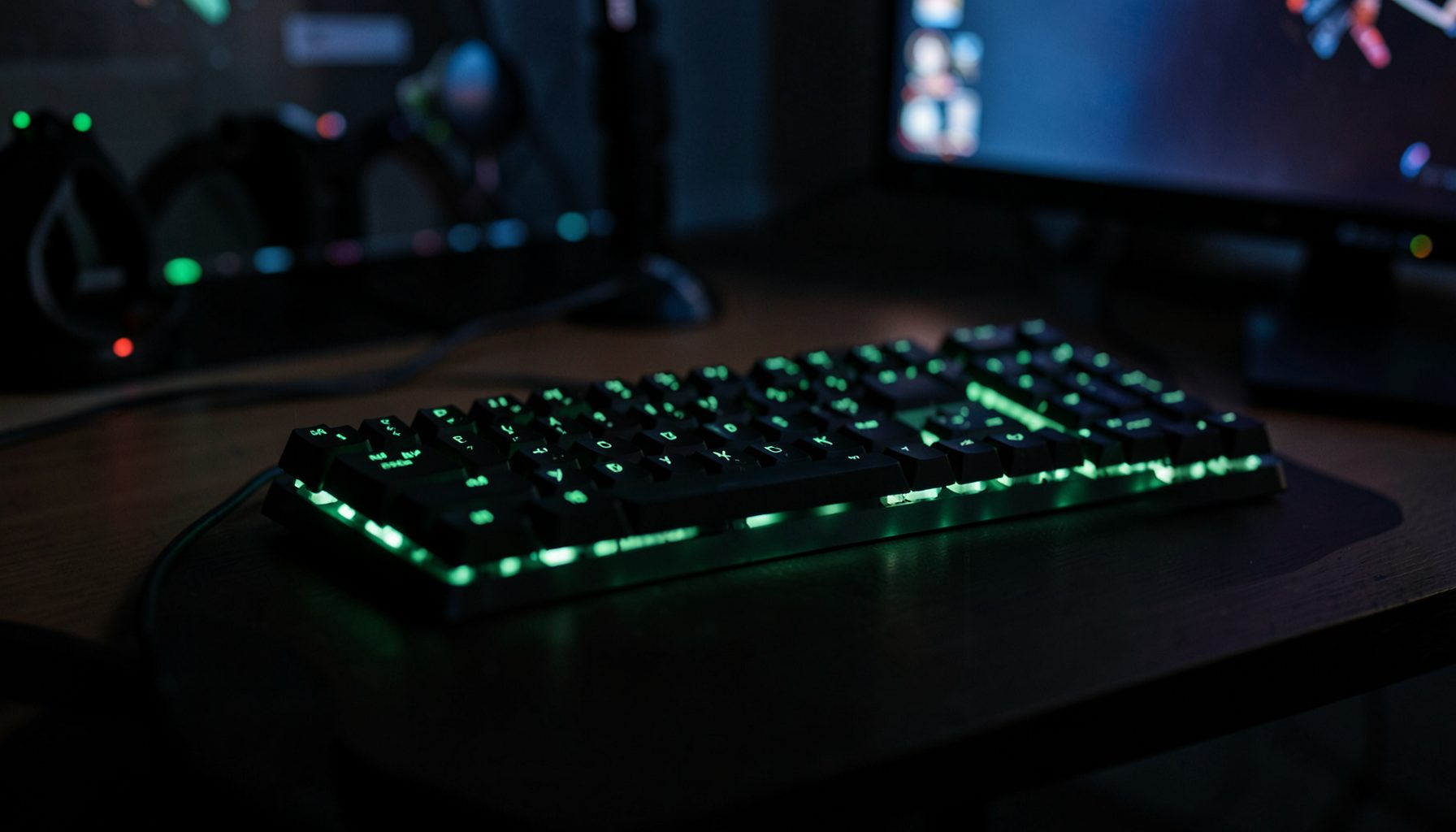
HyperX Alloy Origins 65 Review: Tournament-Ready Compact Control
The HyperX Alloy Origins 65 is designed for players who want a smaller keyboard without giving up the arrow keys and essential navigation controls that disappear from many 60% models. Its 65% layout leaves more room for a low-sensitivity mouse, while retaining a familiar arrangement for everyday use. That makes it a natural candidate for competitive gaming desks, LAN events, and compact PC setups.
This mechanical keyboard combines an aluminum body, HyperX linear switches, double-shot PBT keycaps, per-key RGB lighting, and a detachable USB-C cable. It is a wired-only product, so its appeal depends on whether a stable cable connection matters more to you than wireless flexibility.
The central question is whether the Alloy Origins 65 can handle tournament conditions. Raw responsiveness is only part of the answer. Consistent actuation, reliable stabilizers, portability, software behavior, and the ability to avoid accidental inputs all influence whether a compact keyboard feels ready for serious competition.
Compact Design And Build Quality
The most immediate advantage is the 65% form factor. The keyboard keeps a dedicated arrow-key cluster and several useful navigation keys while removing the function row and traditional number pad. This saves considerable horizontal space compared with a full-size or tenkeyless keyboard, giving the mouse hand greater freedom during fast tracking movements.
HyperX uses a full aluminum body with a brushed finish that feels substantially more rigid than a basic plastic chassis. There is very little flex when pressure is applied to the center, and the keyboard remains planted during rapid play. Its compact footprint also makes it easier to pack in a backpack alongside a gaming laptop, mouse, headset, and other tournament equipment.
Three adjustable feet allow the typing angle to be changed, while rubber pads help prevent sliding. The detachable USB-C connection is convenient for transport and replacement, although the cable exits from a fixed central position rather than offering multiple routing channels. That is a minor detail, but tournament players who use strict cable management may notice it.
The design is restrained rather than aggressively styled. The black aluminum frame and dark keycaps suit most gaming stations, and the RGB lighting supplies the visual flair. The case has enough mass to feel premium without becoming excessively heavy, which is useful for players moving between home and competition venues.
Switches And Gaming Responsiveness
HyperX’s mechanical switches are linear, meaning the keypress travels smoothly without a tactile bump or audible click. They have a relatively light 45-gram operating force and a short 1.8mm actuation point. In games such as Counter-Strike 2, Valorant, and Apex Legends, that combination makes repeated strafing and rapid movement inputs feel quick and predictable.
The switches are rated for up to 80 million keystrokes, which is a strong durability claim for a keyboard in this price range. More important in practice is consistency. The keys actuate evenly across the board, and there is no obvious variation that would make one movement key feel slower or heavier than another.
A 1000Hz polling rate, full N-key rollover, and anti-ghosting support cover the technical basics expected from a modern competitive gaming keyboard. The board can register simultaneous inputs reliably, which is useful when movement, crouching, voice chat shortcuts, and ability commands overlap. It does not offer adjustable actuation or rapid-trigger behavior, however, so it cannot match newer enthusiast keyboards built around Hall effect sensors.
That limitation matters for players chasing the latest competitive features. The Alloy Origins 65 remains responsive, but its performance is fixed at the switch level. There is no software adjustment for actuation distance, dual-function keys, or release sensitivity. For most users, that simplicity is a benefit; for esports enthusiasts seeking every possible advantage, it makes the board less technically advanced.
Stabilizers, Keycaps, And Typing Feel
The double-shot PBT keycaps are one of the strongest elements of the package. PBT is generally more resistant to shine than standard ABS plastic, and the textured surface provides a secure grip during long sessions. The legends are clear, with secondary functions printed where needed, although the compact layout requires some familiarity with shortcuts.
Large keys such as the space bar, Enter key, and Shift keys feel stable during normal use. There is some mechanical noise from the stabilizers, but they are controlled enough for gaming and general typing. The keyboard is not silent, and the hollow resonance of a compact aluminum case can be heard in a quiet room, especially when bottoming out the keys.
The linear switches are comfortable for fast movement, but they may feel too sensitive to users who prefer a defined tactile bump. Players who rest their fingers heavily on the movement keys could occasionally trigger an input earlier than intended. This is a matter of preference rather than a design flaw, and careful key control quickly becomes natural.
For work and communication, the 65% layout requires a short adjustment period. Functions normally found on the missing row are accessed through the Fn layer, and the lack of a dedicated navigation block means some commands require combinations. The arrow keys make the transition easier than it would be on a 60% keyboard, but this is still a gaming-first layout.
Tournament Use And Portability
A wired connection is a major advantage in an organized competitive environment. The Alloy Origins 65 does not depend on battery charge, wireless pairing, or a crowded 2.4GHz spectrum. Plugging in the detachable cable gives the keyboard a direct connection with no need to check battery levels before a match.
The absence of wireless operation is also its clearest weakness. At home, a wireless keyboard can make a desk look cleaner and provide more flexibility for multiple devices. During a tournament, however, wired operation is often preferable because it removes another variable from the setup. The decision depends on whether portability means easy cable use or freedom from cables entirely.
A compact keyboard can improve mouse movement, particularly for players who use a low sensitivity setting. The Alloy Origins 65 leaves enough clearance for broad swipes without forcing the mouse into the edge of the desk. Its arrow keys also preserve practical controls for menus, inventory screens, and non-competitive games.
The board is easy to carry, but the lack of a dedicated travel cover is worth noting. A sleeve or protective case is advisable when the keyboard is transported frequently. Before an event, it is also sensible to save preferred lighting and key settings in the available onboard profiles so the board can be used without depending on venue software.
Lighting And Ngenuity Software
Per-key RGB lighting is bright and evenly visible around the edges of the keycaps. HyperX provides several built-in effects, including static colors and animated patterns, and the lighting can be customized through its Ngenuity software. The RGB system is attractive without distracting from the legends during play.
Ngenuity also handles key remapping, macros, profiles, and other keyboard settings. It is reasonably approachable, though the interface has historically felt less polished than the software ecosystems from larger peripheral brands. The essential controls are present, but users looking for extensive automation or deep hardware customization may find the platform limited.
Onboard memory helps make the keyboard more practical for tournaments. Once settings are stored, basic configurations can travel with the board instead of relying entirely on a background application. It is still worth checking profile behavior before an event, particularly if macros or unusual remaps are involved.
Maintenance is straightforward. Dust and crumbs can be removed with compressed air, while keycaps can be pulled for deeper cleaning. Electronics-safe cleaning methods are preferable; unrelated household products such as specialty care oil should never be applied to switches, keycaps, or the USB connection because residue can attract dust and affect movement.
How It Compares With Similar Compact Keyboards
The Alloy Origins 65 occupies a useful middle ground. It is larger and more practical than a 60% keyboard, but smaller than a tenkeyless model. Its strongest rivals include boards with hot-swappable switches, wireless connectivity, or more advanced optical and magnetic technology.
| Keyboard | Layout | Connection | Key Advantage | Main Limitation |
|---|---|---|---|---|
| HyperX Alloy Origins 65 | 65% | Wired USB-C | Solid aluminum build and reliable linear switches | No wireless or adjustable actuation |
| Razer Huntsman Mini | 60% | Wired USB-C | Very compact size and fast optical switches | No dedicated arrow-key cluster |
| Keychron K6 Pro | 65% | Wired and wireless | Flexible connectivity and hot-swappable design | Less gaming-focused software and tuning |
| SteelSeries Apex Pro Mini | 60% | Wired USB-C | Adjustable actuation and rapid-trigger features | Higher price and reduced layout |
| Keychron Q2 | 65% | Wired USB-C | Premium custom feel and extensive mod potential | Heavy, less convenient for tournament travel |
Compared with the Razer Huntsman Mini, the HyperX model is easier to use outside competitive games because of its arrow keys. Against the Keychron K6 Pro, it gives up wireless connectivity and hot-swapping but delivers a more straightforward plug-and-play gaming experience. The SteelSeries Apex Pro Mini is more technologically ambitious, yet its 60% format and higher cost will not suit every player.
The build quality is also a meaningful differentiator. Some compact keyboards prioritize features over chassis rigidity, while the Alloy Origins 65 feels stable from the first use. It may not be the best platform for extensive switch experimentation, but it is a dependable finished product rather than a project requiring immediate modifications.
Who Should Buy The Alloy Origins 65
The keyboard is a strong match for competitive players who value a compact wired setup, predictable linear switches, and a dedicated arrow-key cluster. It is also suitable for PC builders creating a clean desk layout where mouse clearance matters. The PBT keycaps and aluminum frame give it enough quality for daily use beyond gaming.
It is less compelling for users who expect wireless freedom, enthusiast-level customization, or adjustable magnetic switches. Players who frequently switch between several devices may prefer a board with Bluetooth or 2.4GHz support. Likewise, those who want to tune actuation depth, install different switches, or build a custom sound profile should look elsewhere.
Before buying, consider these priorities:
- Choose it for a stable wired connection and a compact 65% layout.
- Favor it if dedicated arrow keys are important for work, menus, and everyday navigation.
- Skip it if wireless connectivity or hot-swappable switches are essential.
- Consider a Hall effect keyboard if adjustable actuation and rapid-trigger functions are central to your play.
- Add a protective sleeve if the keyboard will travel regularly to LAN events or tournaments.
For its intended audience, the HyperX Alloy Origins 65 is ready for tournament use. It offers dependable input registration, a rigid chassis, useful onboard settings, and a layout that saves space without becoming impractical. Its wired design can even be an advantage in competitive environments where consistency matters more than desk minimalism.
It is not a cutting-edge performance keyboard, and the lack of wireless operation or adjustable actuation prevents it from leading every category. Still, its balance of build quality, speed, portability, and everyday usability makes it a reliable choice for players who want a compact mechanical keyboard that can move from a home gaming PC to a tournament station with minimal compromise.