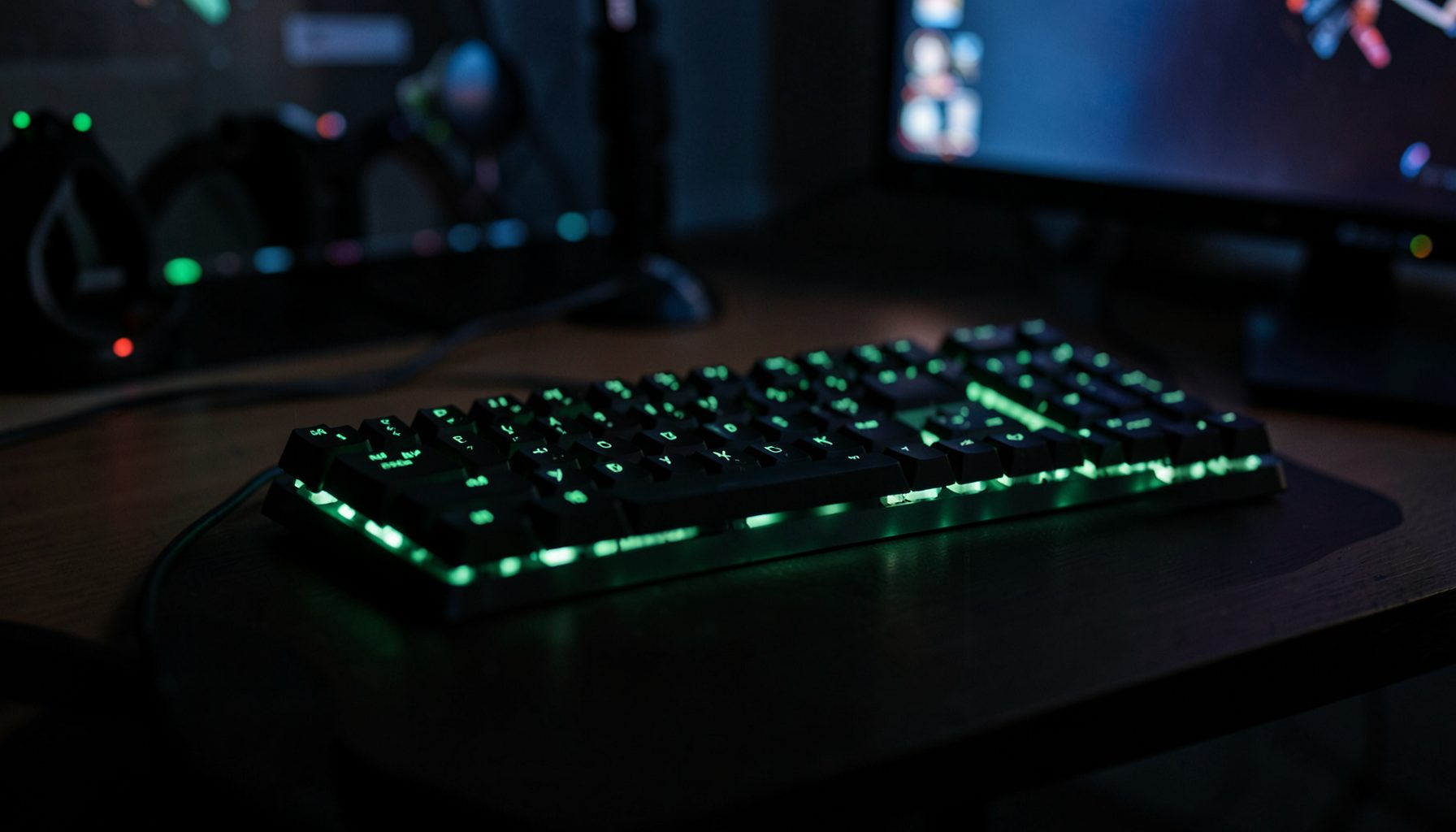
Logitech G Pro X Review: Hot-Swappable Clicky Switches
The Logitech G Pro X is a tenkeyless mechanical keyboard designed around competitive play, fast access, and easy customization. Its defining feature is the hot-swappable switch system, which lets owners replace the included GX Blue clicky switches without buying an entirely new keyboard. That makes it more flexible than many tournament-focused boards that lock users into one switch type.
The board keeps its priorities clear. It has a compact 87-key layout, bright RGB lighting, detachable USB connectivity, programmable controls through Logitech G Hub, and a sturdy plastic-and-metal construction. There is no dedicated number pad, media wheel, or elaborate display, but the reduced footprint leaves more room for a gaming mouse.
This Logitech G Pro X mechanical keyboard review focuses on the areas that matter most to esports players and PC builders: switch response, consistency, customization, comfort, software, cable reliability, and the practical limits of a loud clicky design.
Compact Design For Competitive Desks
The Pro X uses a standard tenkeyless layout, removing the number pad while retaining the function row, navigation cluster, and arrow keys. For FPS games such as Counter-Strike 2, Valorant, and Rainbow Six Siege, that layout is a sensible compromise. It gives the mouse more lateral space without forcing players to use awkward function-layer shortcuts for everyday keys.
Its black chassis is understated, with a low-profile visual design and a removable top plate that helps the keyboard feel more substantial than its mostly plastic shell suggests. The board does not flex excessively under normal use, and rubber feet on the underside provide enough grip for fast movement. A pair of flip-out feet offers a second typing angle, although the keyboard lacks a wrist rest.
The compact footprint is especially useful for players who run a low mouse sensitivity. A wide arm movement is less likely to collide with a full-size keyboard, and the straight front edge keeps the board easy to reposition between matches. The trade-off is that anyone who regularly enters spreadsheets, uses a numpad for productivity, or prefers dedicated media controls will need a separate accessory or a different keyboard.
GX Blue Switch Performance
The standard configuration includes Logitech GX Blue switches. They are clicky, tactile, and relatively crisp, producing a distinct bump followed by an audible click. The actuation point is around 1.9 mm, with an actuation force close to 50 grams. Those specifications place the switches in familiar territory for a gaming mechanical keyboard: light enough for rapid key presses, but resistant enough to reduce some accidental inputs.
In competitive games, the switches feel immediate and predictable. Movement keys have a clear reset, and the tactile event provides useful confirmation that a press has registered. The click can also make repeated inputs feel deliberate, which some players appreciate when tapping, strafing, or switching weapons quickly. The keyboard supports full key rollover and anti-ghosting, so simultaneous inputs are handled reliably during busy gameplay.
The same clicky character that makes the GX Blue switches satisfying can make them divisive. The sound is sharper and louder than that of linear or tactile switches, with additional noise from the keycaps returning on the upstroke. Teammates on a voice call may hear it through an open microphone, and the board is a poor fit for quiet offices, bedrooms shared with another person, or late-night sessions.
The stabilizers on larger keys are functional but not especially refined by enthusiast keyboard standards. The space bar and shift keys can produce some rattle, and the stock switches feel more gaming-focused than premium. Still, the overall key response is consistent enough for competitive use, and the standard key spacing makes the transition from another mechanical keyboard straightforward.
Hot-Swappable Switch Customization
The Pro X’s most valuable feature is its replaceable switch design. The PCB accepts compatible three-pin switches, allowing owners to move from the factory GX Blue clicky switches to linear, tactile, or quieter alternatives. A switch puller is included, so changing the board’s sound and feel does not require soldering equipment or advanced electronics skills.
This makes the keyboard unusually adaptable. A player can begin with clicky switches, later install linear switches for smoother movement, or use a quieter tactile option for shared spaces. Switch replacement also provides a practical way to repair a single failed key rather than replacing the whole keyboard.
Compatibility still requires care. The Pro X is built around a specific socket and plate arrangement, so buyers should verify switch dimensions and pin layout before ordering replacements. Many enthusiast five-pin switches may require modification or may not fit cleanly, while compatible three-pin MX-style switches are the safer choice. The included switch puller is serviceable, but it demands patience to avoid scratching keycaps or bending pins.
Keycap customization is also possible through the standard layout, though the included caps are basic ABS units rather than thick premium PBT. They develop shine with extended use, especially on heavily pressed gaming keys. Replacing them can improve durability and sound, but unusual keycap profiles may interfere with the board’s lighting or the fit of certain keys.
| Feature | Logitech G Pro X | Typical TKL Gaming Keyboard | Practical Impact |
|---|---|---|---|
| Layout | Tenkeyless, 87 keys | Tenkeyless or full-size | Leaves more mouse space while keeping dedicated navigation keys |
| Factory switches | GX Blue clicky | Often fixed linear or tactile switches | Strong feedback, but high noise |
| Switch replacement | Hot-swappable compatible three-pin design | Frequently soldered | Enables feel, sound, and repair upgrades |
| Lighting | Per-key RGB with Logitech G Hub | RGB varies by model | Detailed effects and game profiles |
| Connection | Detachable USB cable | USB, wireless, or both | Stable for esports, less convenient than wireless |
| Media controls | Function-layer shortcuts | Dedicated controls on premium boards | Cleaner layout, but less immediate access |
| Wrist rest | Not included | Varies | Keeps the package compact but reduces comfort for some users |
Gaming Features And G Hub Software
Logitech G Hub provides the main control center for the Pro X. Users can assign macros, remap keys, configure lighting effects, create game-specific profiles, and enable features such as Game Mode. The software recognizes installed Logitech gaming titles and can switch profiles automatically when a supported game launches.
Per-key RGB lighting is bright and even enough for a tournament-style setup, especially with the standard keycaps. Lighting customization ranges from static colors to reactive effects and animated patterns. The system is polished compared with generic keyboard utilities, although G Hub can feel heavier than necessary for someone who wants to set the color once and never revisit it.
Game Mode is helpful when a stray Windows key press could interrupt a match. Players can select which keys are disabled, and profiles allow different settings for different games. Macro support is useful for general PC work and some games, but competitive titles may restrict macros or consider them unacceptable in organized play. The Pro X should be used within the rules of the specific game, league, or tournament.
The lack of onboard controls is noticeable during daily use. There is no volume wheel, dedicated mute button, or small display. Function shortcuts cover basic media commands, but changing volume is slower than reaching for a physical dial. G Hub also needs to be installed for the full configuration experience, even though basic typing and lighting remain available without it.
Comfort And Everyday Use
The flat TKL form factor is comfortable for many gaming positions. The board has enough height to provide a mechanical-keyboard feel without becoming excessively tall, and the adjustable feet allow users to choose between a flatter or steeper angle. Its weight and rubber pads keep it stable during normal play, though aggressive desk movement can still shift it slightly.
The absence of a wrist rest is the main ergonomic omission. Some players prefer to keep their wrists floating while gaming, so it will not matter to everyone. For long typing sessions, however, the front edge can feel firm against the palm, particularly when the rear feet are extended. A separate low-profile wrist rest solves this without changing the board itself.
The clicky switches are pleasant for short bursts and satisfying for deliberate typing. They offer more feedback than many lightweight linear gaming switches, which can help users avoid bottoming out every key. Their noise remains the central limitation. The Pro X is better suited to a private gaming room than a shared workspace, and its sound may become tiring during long sessions.
The detachable cable is convenient for transport and desk maintenance, although the original model uses Micro-USB rather than the newer USB-C standard. The connection is stable when seated correctly, but USB-C is now more common and more durable across modern peripherals. This does not hurt in-game performance, yet it makes the keyboard feel less current than newer enthusiast and esports models.
Competitive Value And Limitations
For esports, the Pro X gets the fundamentals right. Wired USB connectivity avoids battery management and wireless interference, key rollover supports rapid combinations, and the TKL layout gives mouse users useful desk space. The board also feels consistent from key to key, which matters more in a tournament than decorative features.
Its modular switch platform gives it a longer upgrade path than a fixed-switch keyboard. A player who discovers that clicky switches are too loud can change the board’s character without learning to solder. That flexibility is the strongest reason to consider the Pro X over a conventional Logitech gaming keyboard.
However, the board’s age shows in several areas. The Micro-USB cable, basic keycaps, average stabilizers, missing wrist rest, and limited physical controls are less impressive beside newer hot-swappable keyboards. Many current competitors also use five-pin sockets, gasket-mounted cases, sound-dampening materials, USB-C, or wireless connectivity.
The Pro X remains most compelling when discounted or when its software ecosystem is important. Owners of Logitech mice, headsets, and other G-series products may appreciate unified profiles and synchronized lighting. Enthusiasts seeking the best acoustics, deep customization, or premium typing feel will find better hardware elsewhere, but those alternatives may be less convenient for players who want straightforward gaming software.
Best Fit For Different Players
The Logitech G Pro X makes the most sense for buyers who value a compact wired keyboard and want the freedom to change switches later. The following profiles match its strengths particularly well:
- Competitive FPS players who want a reliable tenkeyless layout and clear key feedback.
- Logitech G-series users who prefer to manage lighting and profiles inside G Hub.
- First-time mechanical keyboard owners who want switch customization without soldering.
- Players who enjoy loud, tactile clicky switches and have a private space for gaming.
- PC builders who expect to experiment with linear or quiet tactile switches over time.
It is a weaker choice for anyone who needs silent operation, wireless connectivity, a number pad, or premium stock acoustics. A fixed linear keyboard may be better for rapid repeated inputs, while a newer hot-swappable model with USB-C and five-pin sockets may offer broader enthusiast compatibility.
The board’s appeal therefore depends on its price and the included switch type. At a low sale price, it becomes a practical entry point into modular mechanical keyboards. At a premium price, the compromises are harder to overlook because newer alternatives offer more complete hardware and a quieter, more refined typing experience.
The Logitech G Pro X is a capable esports keyboard with a useful upgrade path rather than a flawless enthusiast product. Its GX Blue switches deliver sharp feedback, the TKL body fits competitive desks, and wired performance is dependable. Hot-swappable sockets give the design lasting value, especially for players who may eventually prefer linear or quieter switches.
For a loud, responsive gaming keyboard that works immediately and can evolve later, the Pro X earns a solid recommendation. Choose it for its compact layout, reliable input, and modular switch design; skip it if silent operation, USB-C, wireless play, or high-end typing refinement matters more. Check current pricing, compare compatible replacement switches, and make the Pro X part of a gaming setup built around the way you actually play.