Logitech G915 X Lightspeed vs. Corsair K100 Air Wireless
Ultra-thin mechanical keyboards promise a difficult balance: the compact feel of a laptop keyboard, the response of mechanical switches, and enough durability for serious desktop use. The Logitech G915 X Lightspeed and Corsair K100 Air Wireless approach that balance with different priorities. Both provide low-profile switches, wireless connectivity, dedicated media controls, and premium aluminum construction, but they feel substantially different under the fingers.
The G915 X is the newer design and a direct refinement of Logitech’s original G915. It uses low-profile GL switches, improved keycaps, USB-C charging, and the company’s Lightspeed wireless system. Corsair’s K100 Air remains one of the thinnest full-size mechanical keyboards available, using Cherry MX Ultra Low Profile tactile switches and Corsair’s fast Slipstream wireless connection.
Testing both keyboards across gaming, office work, wireless use, and extended typing reveals a clear divide. Logitech offers the more adaptable switch selection and longer battery life, while Corsair delivers the fastest, sharpest key response and a more distinctive low-profile feel.
Design And Build Quality
The two keyboards share the same broad design language: a slim black chassis, brushed aluminum construction, floating keycaps, and a full-size layout with a number pad. The G915 X measures roughly 22 mm at its thinnest point, while the K100 Air is even slimmer in areas of its chassis. Neither feels like a lightweight travel keyboard. Their metal frames provide enough rigidity to prevent noticeable flex during intense play or rapid typing.
Logitech’s redesign feels more refined than the first-generation G915. The G915 X replaces the older micro-USB port with USB-C and uses more substantial PBT keycaps. Those caps have a less slippery texture than thin ABS alternatives and should resist visible shine better over years of use. The board still includes a volume roller, media controls, five programmable G-keys, and dedicated buttons for switching connection modes.
Corsair takes a cleaner, more angular approach. The K100 Air includes a prominent metal volume wheel, four dedicated macro keys, profile and media buttons, and a small indicator area for status information. Its extremely thin keycaps contribute to the low height, though their ABS construction can develop a polished surface sooner than Logitech’s PBT caps. The K100 Air is impressively rigid, but its shallow keycaps can feel slightly less substantial when struck with force.
Both models include adjustable feet with two height positions. The Logitech provides a more familiar desktop posture, while the Corsair can feel nearly flat unless its feet are extended. A detachable wrist rest is not included with either keyboard, so users who prefer palm support will need to add one separately.
Switch Feel And Gaming Response
Logitech offers GL Linear, GL Tactile, and GL Clicky switch variants. The Linear version has a smooth, light press suited to rapid movement and repeated key taps. Tactile switches add a defined bump without the loud click of the Clicky model, making them the safest choice for shared workspaces. The Clicky version gives the most traditional mechanical feedback, although its sound is sharper than many full-height click switches.
The G915 X’s low-profile switches actuate at approximately 1.3 mm and have around 3.2 mm of total travel. That is faster and shallower than a conventional Cherry MX switch while retaining enough movement to avoid feeling like a membrane keyboard. During games, the Linear and Tactile versions are easy to control, particularly for repeated strafing, crouching, and ability inputs.
Corsair uses Cherry MX Ultra Low Profile tactile switches in the K100 Air. Their actuation point is around 0.8 mm, with approximately 1.8 mm of total travel. This creates an exceptionally immediate response. The keys seem to register almost as soon as they move, which feels excellent in fast shooters and competitive games. The trade-off is a smaller margin between resting a finger on a key and accidentally activating it.
The K100 Air’s tactile bump is subtle and arrives early. It rewards a light typing style, but heavy-handed users may bottom out against the compact travel more often. Logitech’s switches feel more forgiving and provide a clearer sense of the press completing. For long gaming sessions, the G915 X is easier to adapt to; for maximum speed and a laptop-like key action, Corsair has the stronger personality.
Wireless Reliability And Battery Life
Both keyboards support 2.4 GHz wireless operation, Bluetooth, and wired USB use. Logitech’s Lightspeed connection has a strong reputation for stable performance, and the G915 X maintains that advantage. The included receiver can be used directly or connected through an extension adapter to improve placement near the keyboard. In testing, input remained consistent through a typical desktop setup with the PC positioned under a desk.
Corsair’s Slipstream Wireless system is similarly reliable and allows the K100 Air to share a receiver with compatible Corsair peripherals. Its Bluetooth mode is useful for laptops, tablets, and secondary devices, while a button on the keyboard makes switching between stored connections straightforward. For a desk with several wireless accessories, the shared receiver can reduce cable clutter.
Battery capacity is where Logitech pulls ahead. With RGB lighting disabled, the G915 X can run for up to approximately 800 hours, depending on usage and connection conditions. With lighting enabled, endurance falls substantially, but it still provides several days of practical use. USB-C charging is a welcome improvement, particularly for anyone already carrying a modern phone or laptop cable.
The K100 Air is rated for up to 200 hours with lighting off and around 50 hours with RGB enabled. That remains usable, but frequent lighting users will charge it more often than the Logitech. Corsair’s battery indicator and software monitoring help prevent surprises, although the G915 X is easier to forget about between charges.
| Feature | Logitech G915 X Lightspeed | Corsair K100 Air Wireless |
|---|---|---|
| Switch options | GL Linear, Tactile, or Clicky | Cherry MX Ultra Low Profile Tactile |
| Switch actuation | Approximately 1.3 mm | Approximately 0.8 mm |
| Total key travel | Approximately 3.2 mm | Approximately 1.8 mm |
| Wireless modes | Lightspeed 2.4 GHz, Bluetooth, USB | Slipstream 2.4 GHz, Bluetooth, USB |
| Battery life with lighting off | Up to approximately 800 hours | Up to approximately 200 hours |
| Keycap material | PBT | ABS |
| Layout | Full-size with five G-keys | Full-size with four macro keys |
| Charging connector | USB-C | USB-C |
| Best advantage | Battery life and switch choice | Speed and extremely thin profile |
Gaming, Typing, And Everyday Use
For gaming, both boards deliver low-latency wireless input that feels indistinguishable from a wired connection in ordinary play. The distinction comes from key travel and actuation. Corsair’s short 0.8 mm actuation is particularly satisfying in competitive shooters, rhythm games, and titles that depend on rapid repeated commands. Its keys respond with very little finger movement.
The Logitech is more versatile across genres. Its greater travel makes movement keys easier to modulate, and the Linear or Tactile options suit a wider range of play styles. The five G-keys can hold macros, shortcuts, or application commands, giving the G915 X an advantage for massively multiplayer games, streaming, and productivity software.
Typing exposes a different set of preferences. The G915 X has a more conventional mechanical rhythm despite its thin design. Tactile and Clicky models provide enough feedback to support accurate touch typing, while the PBT keycaps keep fingers anchored. The K100 Air is quick and quiet by mechanical standards, but the very shallow stroke can take several days to master. Users accustomed to laptop keyboards will likely adjust faster.
Neither keyboard is silent. The G915 X Clicky version is clearly unsuitable for a quiet office, and its stabilizers can produce noticeable noise on the spacebar and larger keys. The Linear and Tactile models are less intrusive. Corsair’s switches produce a light, high-pitched bottom-out sound, with the thin chassis adding some resonance. O-rings are not a simple solution because they can further reduce the already short travel.
Software, Lighting, And Customization
Logitech G Hub controls the G915 X’s RGB lighting, key assignments, profiles, macros, and wireless settings. The five dedicated G-keys make profile-based customization practical, and onboard memory allows selected settings to remain available without the software running. Logitech’s interface is generally approachable, although deeper macro and application profile features can require some navigation.
Corsair’s iCUE software is more extensive. It supports complex macros, per-key RGB effects, profile switching, hardware lighting, and integration with other Corsair components. The K100 Air also includes four macro buttons that are easy to reach without moving the hand far from the main key area. For users already running Corsair fans, memory, cooling, or lighting, iCUE provides a unified control center.
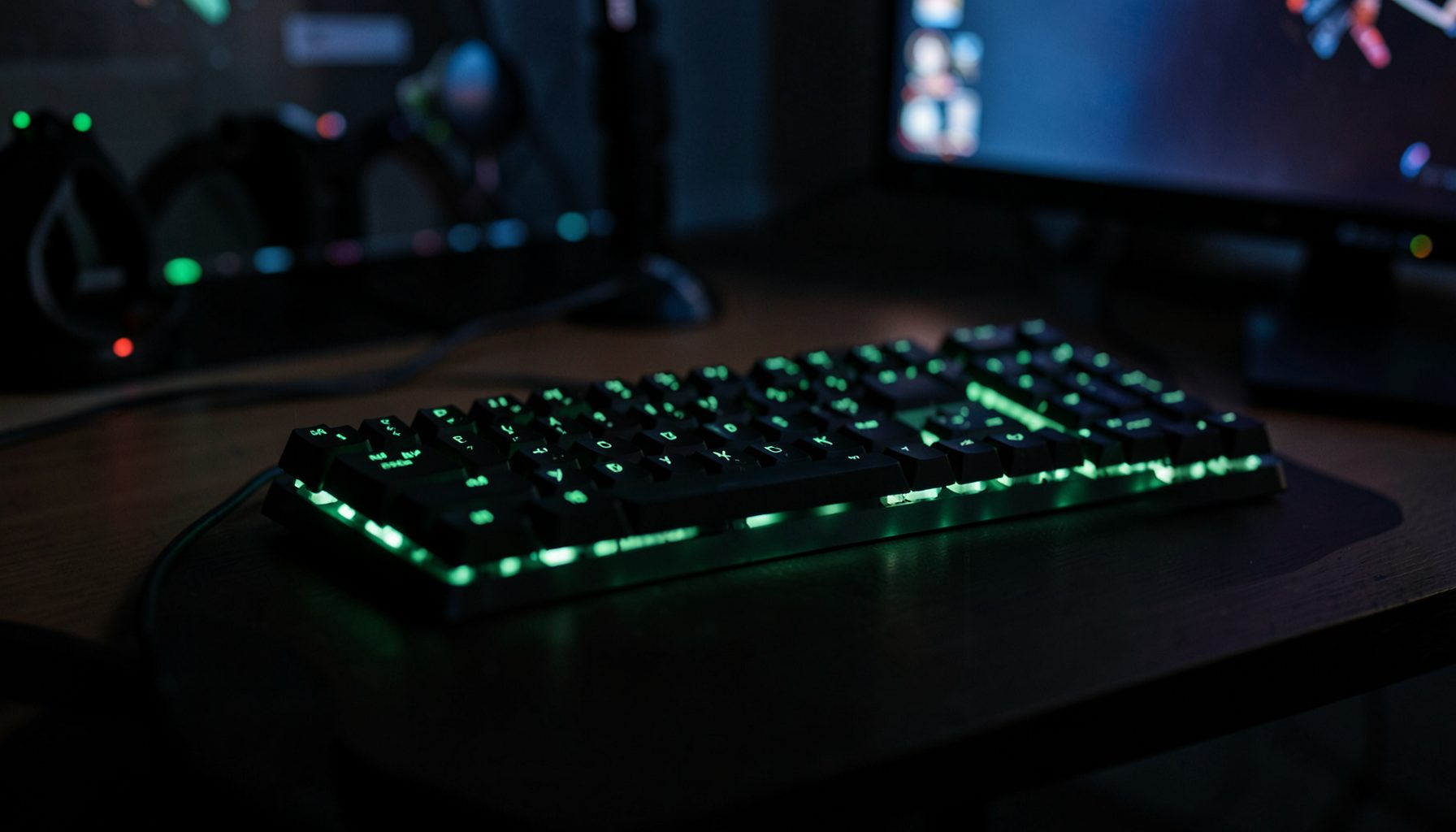
The K100 Air’s lighting is bright and vivid, with clear illumination around the floating keycaps. Logitech’s RGB implementation is equally attractive, but the G915 X’s key legends and cap design produce a slightly more restrained appearance. Both keyboards can be configured for static colors, reactive effects, waves, and game-specific profiles.
A practical difference is the amount of software overhead. Either keyboard works as a basic input device without its companion application, but advanced customization is tied to the respective ecosystem. Logitech is the simpler choice for assigning a few shortcuts, while Corsair offers greater depth for users who enjoy building layered profiles and elaborate lighting scenes.
Price, Compatibility, And Ownership Value
Pricing varies by switch type, sales, and regional availability, but both keyboards sit firmly in the premium category. The G915 X generally offers stronger long-term value because it combines a choice of switch characteristics, better keycaps, longer battery life, and a newer USB-C design. Its dedicated controls also make the price easier to justify for users who want a full-featured desktop keyboard.
The K100 Air remains appealing when its thinness and fast switches are the priority. It is closer to a premium laptop keyboard with mechanical internals than to a standard mechanical board that has been shortened. That distinctive feel is difficult to replicate, and users who prefer shallow actuation may consider the extra cost worthwhile.
Compatibility is broad on both models. Each can connect to Windows PCs through its wireless receiver, pair with Bluetooth devices, and operate through USB. Console compatibility depends on the console and game, while software customization is primarily designed for Windows. Mac users can use the basic keyboard functions, but some media keys, macros, and configuration features may be limited.
For a wider view of how premium peripherals fit into a complete mobile setup, this gaming laptop guide is useful when matching a wireless keyboard with a portable gaming system. A keyboard like either of these can turn a laptop into a more comfortable desktop workstation without giving up wireless convenience.
Which Keyboard Fits Your Setup
The Logitech G915 X is the better all-rounder. Its switch range accommodates different preferences, the PBT keycaps feel durable, and its battery can last for weeks or months depending on lighting habits. It is the safer recommendation for mixed gaming and office use, especially when the keyboard will be shared with other people or used for long writing sessions.
The Corsair K100 Air is the specialist option. Its ultra-short actuation, exceptionally thin profile, and tactile Cherry switches create a fast, unusual experience that competitive players and laptop-keyboard fans may prefer. The shorter battery life and ABS keycaps are meaningful compromises, but neither undermines its core appeal.
- Choose the G915 X Linear for smooth, fast gaming and quiet operation.
- Choose the G915 X Tactile for balanced typing feedback and everyday versatility.
- Choose the G915 X Clicky when audible mechanical feedback is a major priority.
- Choose the K100 Air for the thinnest profile and fastest key activation.
- Choose the K100 Air if you already use Corsair hardware and want deeper iCUE integration.
The Logitech G915 X Lightspeed wins this comparison as the more complete premium keyboard, while the Corsair K100 Air Wireless delivers the more specialized low-profile experience. Compare the switch feel, battery expectations, and software ecosystem before buying, then choose the model that matches the way you actually play and work.