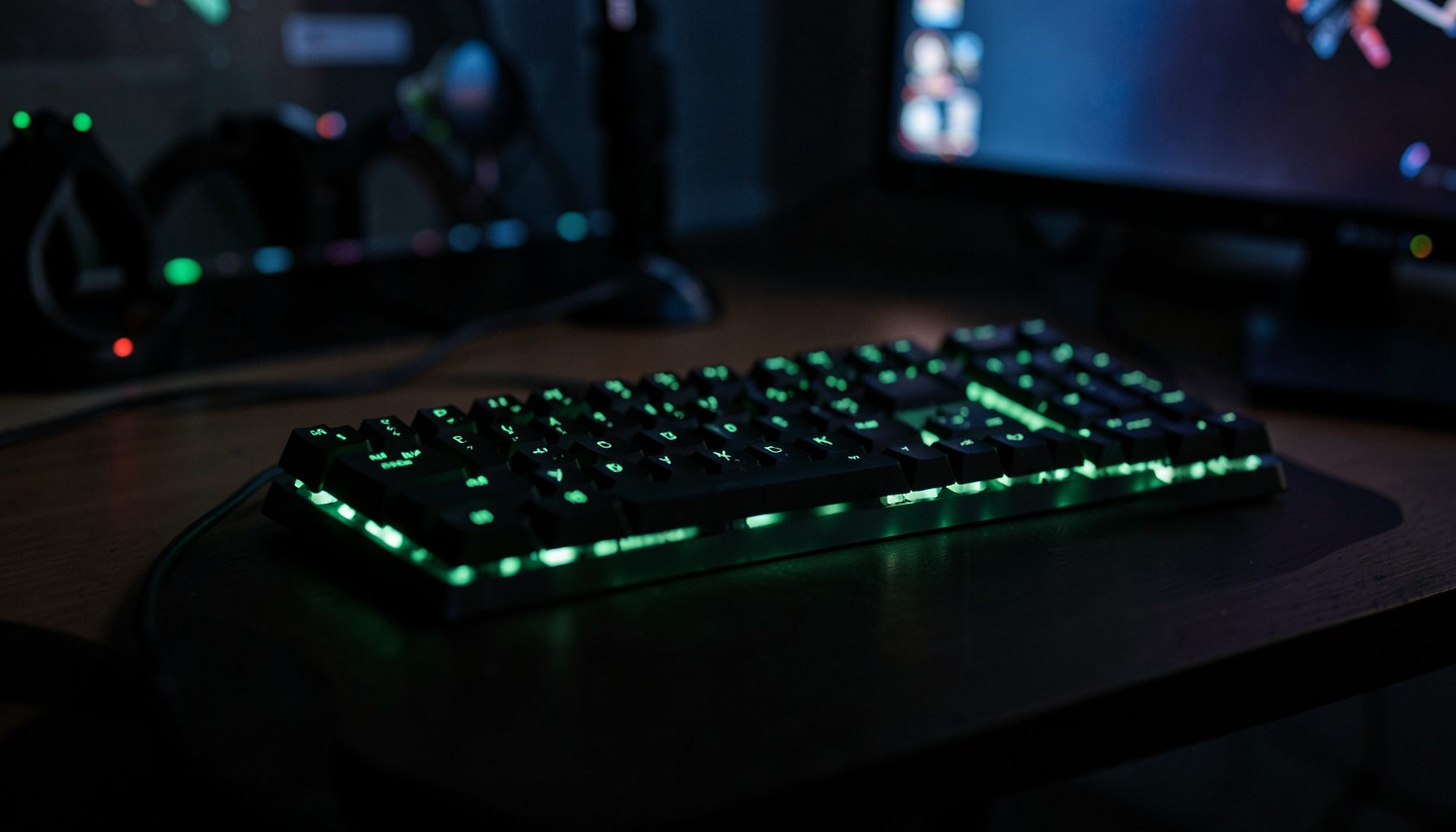
Mechanical keyboard sound comparison on a deskmat
Mounting an OEM, Cherry, or Holy Panda switch on a deskmat can change the character of a keyboard as much as swapping keycaps. This mechanical keyboard sound comparison places the three options under similar conditions to reveal how each handles top-out, bottom-out, case resonance, and the reflective surface of a large gaming mat.
OEM switches provide the least predictable baseline because the label covers many manufacturers and force ratings. Cherry offers a familiar reference point, while Holy Panda delivers a distinctly deeper and smoother linear sound. The most useful result depends on your keyboard, mat, keycaps, and whether you prefer a sharp clack, a muted thock, or the clean separation between switch and case.
Why the deskmat changes the result
A deskmat acts as an acoustic filter. Dense cloth absorbs some high-frequency energy that would otherwise bounce from a bare wooden or laminate desk, while a harder plastic mat may leave more of the original brightness intact. The mat cannot eliminate resonance inside the keyboard, however, and the sound of the switch still blends with the plate, housing, stabilised keys, and empty case cavity.
For a controlled comparison, each sample was tested with the same keycaps and stabilised spacebar, a fixed microphone position, and normal typing or gaming activity. A large cloth deskmat provided the common surface. OEM switches came from a donor keyboard, while the Cherry and Holy Panda samples were checked in the comparison board wherever their footprints allowed. This exposes a practical limitation: switch sound is never completely independent of the rest of the build.
Establishing the OEM baseline
OEM is a broad category rather than a single switch model. The same designation can cover light tactile, clicky, and linear mechanisms from different suppliers. Many entry-level keyboards also use thin plastic plates, elevated cases, and hollow-feeling housings. These components give an OEM board a brighter attack and more obvious case resonance than a well-mounted custom keyboard.
The stock switches themselves may sound crisp when new, but age changes their voice. Spring resonance, stem friction, and dried factory lubricant can introduce rattles or a scratchy top-out. Lubrication can tame those irregularities, though it may also reduce the sharp edge of the original sound. This makes an aged OEM switch difficult to judge without knowing its history.
For listeners, the OEM baseline is usually the most revealing. Its brighter top-out reveals the surrounding case, while its bottom-out exposes thin plates and loose fitting. Cherry generally sounds more contained in the same test, and a genuine Holy Panda sample produces the lowest, roundest result of the three.
Cherry MX switches on the mat
Cherry MX provides a useful middle ground in both feel and sound. The Red is linear with a relatively bright top-out, the Black is linear with a slightly firmer and deeper bottom-out, and the Brown adds a clearly defined tactile bump. On cloth, the Brown’s bump separates the sound into two events, making its typing rhythm more obvious than that of either linear option.
Compared with the OEM sample, Cherry sounds cleaner and less hollow. The plastic housings retain enough definition to preserve a crisp “clack” without letting the case dominate. Red has the sharpest upper edge, Brown sits between Red and Black, and Black delivers the firmest linear note. The differences are audible under quiet conditions, although a thick keycap or noisy gaming session can conceal some of them.
Cherry is therefore the balanced choice for players who want familiar acoustics without paying a premium for boutique switches. It remains more articulate than Holy Panda, which may sound overly bright to some listeners on a hard desk. On a cloth mat, that extra definition becomes controlled enough for extended use while remaining easy to hear in recordings.
Holy Panda switches on the mat
Holy Panda switches, particularly the widely recognised Xinhai-based models, are known for a long spring, a smooth linear travel, and factory lubrication around the stem and rails. Their housing construction produces a fuller sound than most Cherry MX options. The result is often described as creamy, although the exact pitch depends on the spring weight, batch, and amount of factory lubricant present.
On the deskmat, the bottom-out forms a dense, rounded clack with fewer piercing highs. The upper travel is subdued, and the overall note sits lower than the Cherry Red or the typical OEM switch. This can make rapid gaming inputs sound controlled and relatively unintrusive. Typing reveals a slightly softer attack, but repeated presses do not develop the thin ringing edge found on some plastic-plate OEM boards.
Authenticity and condition require extra care. Holy Panda’s long-standing popularity has led to numerous lookalikes, modified switches, and inconsistent factory lubrication. The contact leaves may help identify a particular model, while the weight marking and spring construction can reveal inconsistencies. A switch that feels gritty in one switch and smooth in the next may have uneven lubricant rather than the uniform factory feel buyers expect.
Comparing pitch, volume, and character
The clearest hierarchy appears in pitch. The OEM sample produced the highest and most hollow attack, Cherry occupied the middle range, and Holy Panda delivered the lowest, most rounded profile. That ordering can change when an OEM board uses a thick aluminium plate or a gasket mount, but the basic character remains distinct when the surrounding build is similar.
Volume follows a less predictable pattern. OEM switches can be very loud because their sharp top-out excites the case, while Holy Panda can be physically heavy yet comparatively restrained in the recording. Cherry produced the clearest standalone click, giving each keystroke a defined outline. The mat reduced desk reflection for all three samples, making the difference between switch sound and case sound easier to identify.
For gaming, the Cherry options remain the most transparent in voice-chat recordings. Holy Panda suits players who want audible feedback without an aggressive edge, while an OEM board appeals to listeners who enjoy the raw, mechanical character of a stock gaming keyboard. None is automatically the quietest, because plate material, stabiliser tuning, keycaps, and the microphone’s distance from the case can outweigh small switch differences.
Buying switches in Australia
Australian keyboard prices are usually listed in Australian dollars, so exchange-rate movements can alter the apparent value of imported switch sets. Domestic retail prices generally include 10 per cent GST, while overseas listings may add tax, freight, and payment fees later. Sydney, Melbourne, and Brisbane each have established gaming communities and specialist keyboard retailers, providing a useful local option for testing switches before committing to a large order.
Small overseas purchases have their own customs treatment. For a direct shipment valued below A$1,000, duty is generally not the main charge, but GST can still apply to low-value imported goods. Parcels may travel through Australia Post or StarTrack, and delivery times can vary enough to affect stock planning for a custom build. Marking every bag and paying for tracked shipping reduces the chance of a delayed order arriving with missing switches.
Seller checks are especially important for unfamiliar marketplace listings. Confirm that the product name, switch quantity, weight markings, and return policy all match, and look for clear photographs rather than a reused product image. A poorly targeted search can even surface a casino bonus site beside keyboard sellers; that is a reason to refine the search, not evidence that the switch supplier is legitimate. Local stores and established Australian custom-keyboard communities often provide a clearer warranty and replacement process than an anonymous overseas seller.
Choosing a sound profile with confidence
Choose Cherry Red for a bright, familiar linear clack, Cherry Black for a firmer and deeper linear note, or Cherry Brown when a distinct tactile bump should shape every keystroke. Choose Holy Panda when a smooth travel, muted top-out, and full-bodied bottom-out matter more than the crisp separation of a Cherry switch. OEM switches make sense when maintaining an existing board or preserving its original sound is the priority.
Test a small quantity on the actual keyboard and mat whenever possible. A switch that sounds excellent in a bare case can become deeper after mounting, while adding foam or tape can shift the balance toward a muted thock. Record both typing and rapid gaming input, then check the result through a microphone rather than judging it only at desk level.
Pick the profile that matches your priorities, verify the switch markings and seller reputation, and test a small batch before ordering enough for a complete build. Your own keyboard, deskmat, and room acoustics will provide the most reliable final verdict.