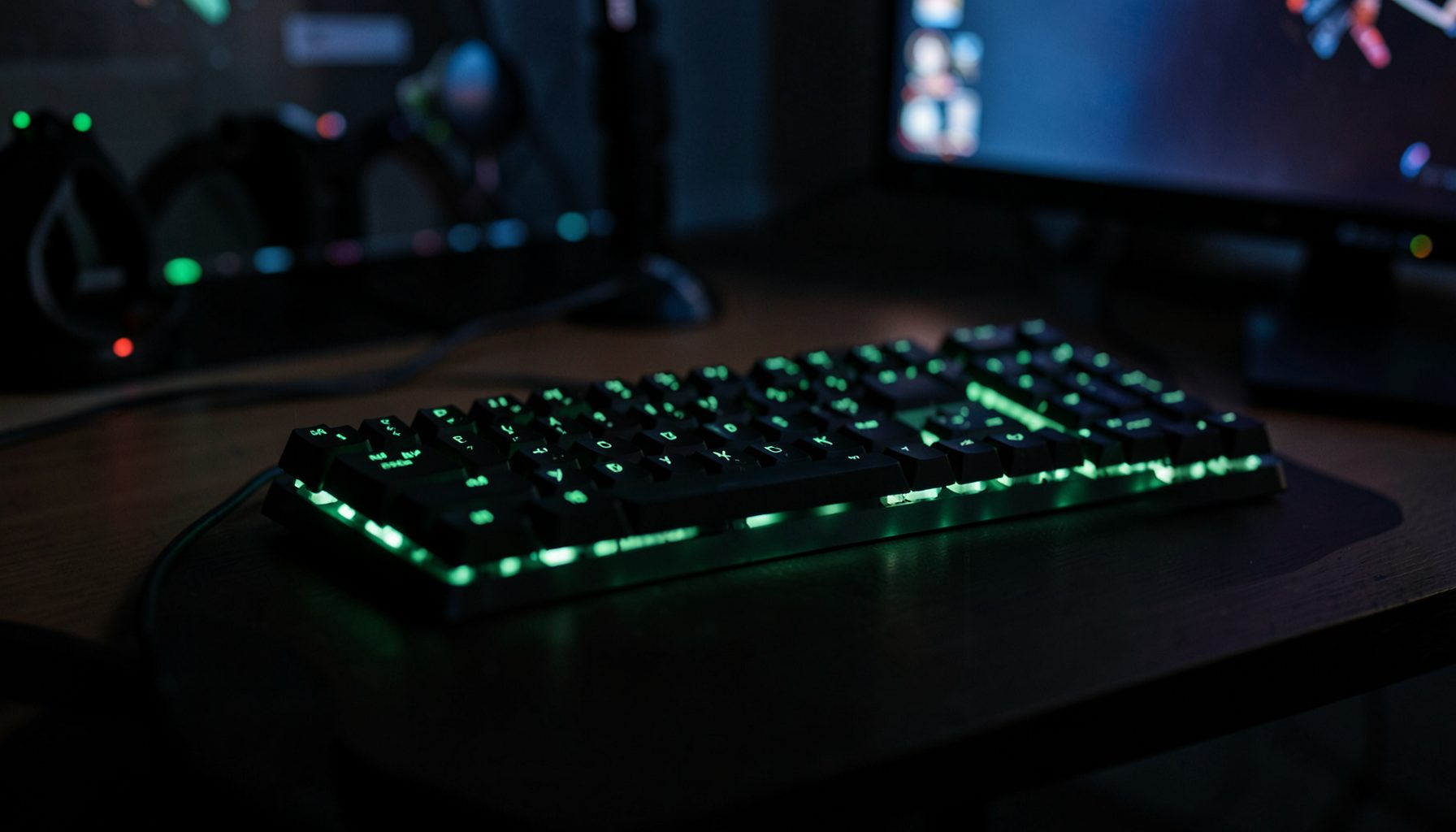
ROG Falchion Ace review: a 68% gaming keyboard with 8000Hz polling
The compact mechanical keyboard category has matured into one of the most competitive corners of the peripherals market, with enthusiasts increasingly favouring smaller footprints that free up desk space for wide mouse swipes and ambitious multi-monitor setups. The Asus ROG Falchion Ace slots squarely into that trend, offering a 68% layout that strips away the numeric keypad, function row and most of the navigation cluster while keeping the arrow keys intact. For Australian gamers juggling widescreen gaming at home and the occasional LAN meet-up, that balance is genuinely useful rather than a marketing afterthought.
Under the hood, the headline draw is an 8000Hz polling rate, which is eight times faster than the 1000Hz standard that has long dominated gaming keyboards. Combined with ROG's own NX mechanical switches and an unusually dense feature list, the Falchion Ace positions itself as a serious competitive tool. Whether it earns a place in your setup depends on how the technology translates into the kind of real-world advantages competitive Australian players actually notice during ranked grind sessions.
This review draws on extended testing across FPS, MMO and productivity workloads, with comparisons against the wider compact keyboard landscape. For context on how display hardware ties into a competitive rig, our earlier write-up of the LG 32GS95UE OLED panel covers the monitor side of the equation that often travels hand in hand with a sub-millisecond keyboard.
Design and Build Quality
The Falchion Ace carries the familiar ROG aggressive aesthetic, but at just 315mm wide it sits comfortably next to a wide mousepad without forcing players to compromise on aim travel. The aluminium top plate is one of the more noticeable upgrades over the original Falchion, giving the chassis a reassuring weight of around 1.1kg that keeps the board planted during intense Valorant or CS2 sessions. The footprint is small, but it does not feel cheap in the hand, and the magnetic feet plus included silicone wrist rest make long nights considerably more manageable.
Up top, a row of physical media controls and a rotary volume knob keep things tactile without leaning entirely on software. The keyboard also ships with a hard plastic cover that doubles as protection during transit, which is a thoughtful inclusion given how many Australian gamers cart gear to meet-ups at Brisbane's casual gaming nights or the Barwon Club LAN gatherings south-west of Melbourne. RCM compliance markings are clearly visible on the underside, which matters for anyone kitting out a home office under Australia's strict consumer electronics standards.
One quirk worth flagging is the dual-sided front bezel, where the brushed finish scratches more easily than expected. Players who rest their wrists firmly against the keyboard during long Overwatch 2 ranked pushes may want to treat the surface with a little more care than they would a typical plastic deck, particularly if the board will live on a shared family PC for years to come.
Switches and Typing Feel
ROG equips the Falchion Ace with its NX Red linear switches out of the box, factory-lubed and tuned for a relatively smooth stroke. The 45g actuation force lands in the sweet spot most FPS players prefer, and the pre-lubed stabilisers on the larger keys do not rattle in a way that distracts from headset audio cues. For typists used to Cherry MX Reds, the feel is recognisably similar with a slightly shorter pre-travel that rewards quick double-taps and counter-strafes.
Sound profile sits on the louder side compared to silent linear options, so anyone sharing a Sydney terrace with housemates in adjoining rooms should be mindful of click-clack complaints during late-night grind sessions. Hot-swap support is not present on this model, meaning tinkerers cannot swap in third-party stems without a soldering iron. For an audience that prefers plug-and-play simplicity, that is less of a concern and arguably keeps the price aligned with the value proposition Asus is chasing.
PBT keycaps would have been welcome in this price bracket, but the ABS doubleshot caps hold their legends well through heavy use. After several weeks of daily Apex Legends and document writing, none of the printed characters showed the characteristic shine that plagues cheaper ABS sets, which is encouraging for a board marketed toward gamers who type as much as they shoot.
8000Hz Polling and Real-World Latency
Polling rate is the headline feature that Asus leans on heavily, and it is worth unpacking what 8000Hz actually delivers. Each second the keyboard sends 8000 reports of its state to the PC, meaning the gap between key press and on-screen action drops from a 1ms theoretical floor at 1000Hz to roughly 0.125ms. That figure sounds tiny, and in absolute terms it is. In practical play, however, the gains depend hugely on the rest of the chain.
Pairing the Falchion Ace with a high-end desktop running a GeForce RTX 4080 at 240Hz produces measurable but modest improvements in input consistency. Monitor latency, game engine tick rate and internet connection each contribute their own milliseconds, with Australian NBN connections typically adding 10 to 30ms to online matchmaking on top of local frame times. Players in regional hubs like Adelaide or Perth often see higher routing hops, which means the 8000Hz advantage gets buried under network jitter unless the rest of the rig is dialed in.
What 8000Hz does deliver reliably is steadier motion in single-player and offline scenarios, especially during rapid camera turns where sub-millisecond polling helps reduce micro-stutter patterns caused by bursty input reporting. It is also a forward-proofing feature; as engines and mice begin to take advantage of higher polling across the ecosystem, those who adopt early will be ready when the difference starts to compound.
RGB, Software and Battery Life
Aura Sync RGB runs the full width of the Falchion Ace, with per-key customisation and a strip of underglow that produces a subtle ambient halo on the desk. Effects render smoothly and the LEDs are bright enough to read clearly through the keycaps, which is useful for players who have memorised their keybind layouts but still appreciate a flash of cyan on the WASD cluster. The software itself, Armoury Crate, remains the same divisive interface Australians either tolerate or work around, with a few extra options specifically for the polling-rate override and wireless channel selection.
Wireless connectivity is one of the Falchion Ace's quieter strengths. ROG SpeedNova 2.4GHz wireless delivers lower latency than Bluetooth and roughly 50 hours of battery life with lighting dialled to moderate brightness. Charging happens through a front-facing USB-C port that conveniently keeps the cable away from mouse travel space, important for low-sensitivity players running 40cm-plus 360-degree sweeps on a wide mat. A full charge from a standard Australian 240V outlet via a phone charger takes about two and a half hours.
Travelling with the board is straightforward thanks to the included cover, although the lack of internal storage for the dongle is an odd omission. That means a small loose receiver rattling around the bottom of a backpack, which anyone who has misplaced a wireless dongle during a Greyhound trip up the coast will find mildly stressful.
Gaming Performance and Daily Use
In ranked Valorant matches across local Sydney servers, the Falchion Ace delivered consistent input timing with no audible chatter or missed actuations over hundreds of rounds. The 68% layout keeps essential keys within reach without forcing pinky stretching for movement, and the dedicated arrow cluster means quick inventory swaps in Escape from Tarkov or stash management in Diablo 4 do not require lifting hands off the home row.
Productivity use is where the compact layout starts to push back. Writers, programmers and spreadsheet power users will notice the absence of a function row and the compressed navigation cluster, particularly for shortcuts like Alt+F4 or Ctrl+Shift+F that require a hold pattern uncomfortable on a 65% board. For a hybrid work-and-game rig that doubles as a daytime office tool, that is worth weighing against the dedicated arrow key convenience.
Comfort during long sessions is solid once the included wrist rest is attached. The silicone is firm enough to keep wrists neutral and easy to wipe clean after sweaty summer gaming in Brisbane or Darwin humidity, which Australian readers will appreciate given how many of us game through sweltering evenings without air conditioning cranked up.
Who Should Buy the Asus ROG Falchion Ace
- Players prioritising compact desk real estate without sacrificing arrow keys
- Competitive FPS enthusiasts wanting 8000Hz polling as a future-proofing investment
- Aussies who travel to LANs or esports nights and need a tough, transportable board
- Buyers comfortable relying on Armoury Crate for tuning and lighting control
- Gamers running a wireless-first setup who want long battery and low-latency 2.4GHz
- Tinkerers who want hot-swap PCB support and PBT keycaps should look elsewhere
- Anyone working heavily in spreadsheets or code daily may prefer a 75% or full-size board
Pair the Falchion Ace with a high-refresh OLED display, a low-DPI wireless mouse and a desk mat sized for sweeping aim, and the full benefit of 8000Hz polling finally clicks into place. Drop into a local Centrecom, Mwave or Scorptec store to test the layout in person before committing, and keep an eye on Aussie outlets for the rotating promotional pricing Asus occasionally offers through authorised ROG resellers. The standard Australian Consumer Law guarantees also mean any warranty claim can be pushed through the local retailer for added peace of mind.