Best 4K 144Hz Gaming Monitors for RTX 5080 Builds
An RTX 5080 is designed to make high-refresh 4K gaming practical rather than aspirational. With DLSS, ray tracing improvements and frame generation available in supported games, Nvidia’s current high-end GPU can drive demanding titles at frame rates that justify a premium monitor. The challenge is choosing a panel that turns that performance into a better experience instead of exposing distracting weaknesses such as blooming, motion blur, poor HDR or inconsistent DisplayPort support.
For most Australian PC builders, the decision comes down to OLED versus Mini-LED, then to size, connectivity and warranty terms. A 32-inch 4K display offers the best balance of sharpness and immersion for a desktop, while 27-inch models suit smaller Melbourne or Sydney workspaces. A 144Hz screen is the baseline, although many current OLED options run at 240Hz and provide useful headroom for competitive games.
Why The RTX 5080 Suits 4K High Refresh
The RTX 5080 has enough rasterisation performance for excellent 4K results in many modern games, but average frame rate varies dramatically with the settings used. Competitive shooters can exceed 144 frames per second with sensible options, while cinematic games with path tracing may need DLSS Super Resolution and frame generation to approach that target. A monitor should therefore support variable refresh rate rather than relying on a fixed 144Hz signal.
Nvidia G-Sync Compatible support, Adaptive-Sync and a broad VRR range help prevent tearing when the GPU moves between 90 and 160 frames per second. This matters more at 4K than at 1080p because ultra settings, ray tracing and high-resolution textures create larger frame-time swings. A good 4K gaming monitor should remain smooth when the RTX 5080 cannot hold its maximum refresh rate.
DisplayPort 2.1 is valuable for owners who want the simplest route to 4K at 240Hz, particularly with monitors that use UHBR bandwidth. HDMI 2.1 remains essential for a PlayStation 5 or Xbox Series X connection, and it is also useful for a living-room PC setup. Check the exact port specification rather than assuming every monitor labelled “gaming” offers full bandwidth; some models require Display Stream Compression to reach their highest refresh mode.
OLED Delivers The Strongest Gaming Contrast
OLED remains the most impressive option for dark-room gaming. Each pixel controls its own light, producing effectively perfect black levels without the haloing that can appear around bright objects on a conventional LCD. In games such as Alan Wake 2, Cyberpunk 2077 and Resident Evil, the contrast and shadow detail can make a 32-inch 4K OLED feel significantly more cinematic than a similarly priced IPS display.
Pixel response is another major advantage. OLED transitions are extremely fast, so moving objects retain clarity even when the refresh rate is high. This makes 240Hz OLED monitors particularly appealing for fast shooters, racing games and desktop scrolling. The difference from 144Hz is not always dramatic in slower single-player games, but low persistence and quick transitions are easy to appreciate in Counter-Strike 2, Valorant or Apex Legends.
The main compromise is burn-in risk. Static taskbars, browser interfaces and game HUDs can cause uneven pixel wear over a long period, although modern monitors use pixel shifting, panel refresh cycles, logo dimming and screen savers to reduce the problem. These features need to be enabled, and an OLED is a better match for someone who varies content than for a workstation displaying the same accounting or coding interface every day.
Brightness also needs careful interpretation. OLED monitors can look spectacular in controlled lighting, but full-screen white scenes are often less bright than on Mini-LED LCDs. Glossy QD-OLED screens produce rich colour and punchy highlights, yet reflections can become annoying in a bright Brisbane room or near a window. A matte OLED is more forgiving for daytime use, though its coating may slightly soften the image.
Mini-LED Offers Brighter HDR And Fewer Worries
Mini-LED monitors use an LCD panel with a dense backlight array divided into hundreds or thousands of local dimming zones. They cannot switch individual pixels completely off, so they do not match OLED’s black level or response time. However, they can produce higher sustained brightness, making explosions, sunlight and bright HDR environments more convincing in a room with strong ambient light.
A good 4K 144Hz Mini-LED monitor is often the more practical choice for mixed use. It handles desktop applications, static windows and long gaming sessions without the same burn-in concern. This is relevant for PC builders who use one display for work during the day and games at night. VA-based models typically provide strong contrast, while IPS-based Mini-LED screens can offer wider viewing angles and cleaner motion.
Local dimming quality separates excellent Mini-LED displays from ordinary ones. A small number of zones can create visible blooming around subtitles, mouse pointers and bright stars against black backgrounds. More zones usually improve control, but software algorithms, panel contrast and firmware tuning matter just as much. Reviews should be checked for measurements of HDR brightness, black levels and dimming behaviour instead of relying on the “Mini-LED” label alone.
Models such as the Cooler Master Tempest GP27U and Innocn 32M2V established the appeal of 4K Mini-LED at high refresh rates, while newer 32-inch products offer more refined HDR and connectivity. Availability in Australia can be inconsistent, so confirm the local warranty process before buying an imported unit. A low headline price is less attractive when a faulty panel must be returned overseas.
Size Refresh Rate And Desk Distance Matter
A 32-inch 4K monitor provides a pixel density of roughly 138 pixels per inch, which is sharp enough for detailed text and high-resolution game worlds without requiring extreme scaling. It is the natural fit for an RTX 5080 build with a large desk. A viewing distance of around 70 to 90 centimetres usually allows the entire screen to sit comfortably within the user’s field of vision.
A 27-inch 4K display is sharper at roughly 163 pixels per inch and can look superb for productivity, but menus and text may require 125% or 150% scaling in Windows. It is a sensible option for compact desks or apartment setups where the monitor sits closer to the face. Ultrawide alternatives can improve immersion, although they demand more GPU horsepower and do not always receive the same console or game support as standard 16:9 models.
The difference between 144Hz and 240Hz depends on the games being played. A 144Hz monitor is sufficient for most story-driven titles and provides a substantial improvement over 60Hz. A 240Hz OLED is worthwhile for competitive players who can actually produce high frame rates, but it should not be purchased at the expense of HDR quality, ergonomic adjustment or reliable ports.
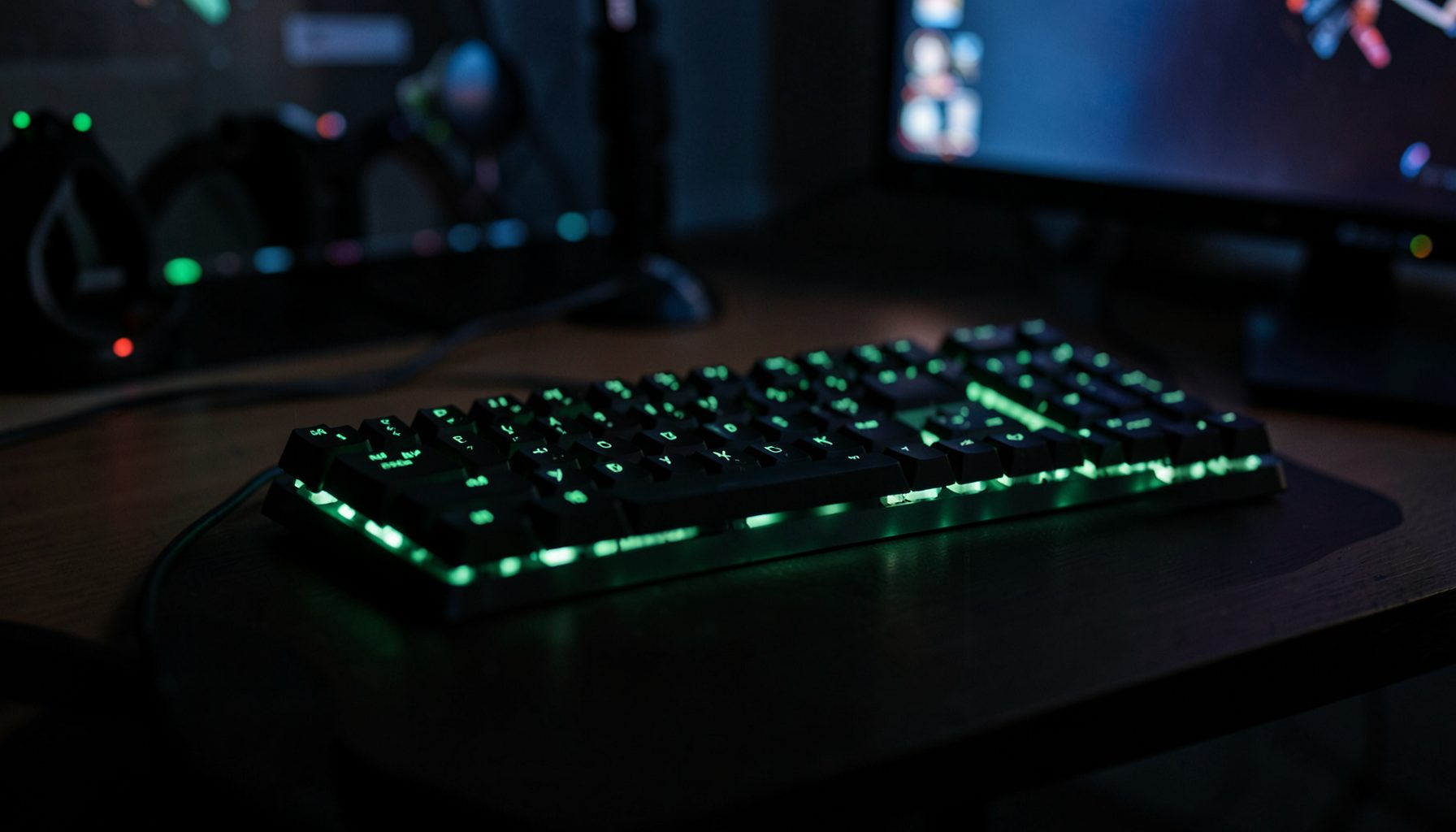
OLED monitor owners should also think about desk habits. Hide the Windows taskbar, use a short screen timeout and vary static applications where possible. A keyboard with a compact footprint can leave more room for the display and mouse; this compact keyboard review is relevant for builders trying to keep a high-refresh setup tidy without sacrificing dedicated controls.
Australian Buying And Warranty Considerations
Australian pricing includes a 10% Goods and Services Tax, and advertised prices from established retailers generally show the amount payable at checkout. Compare the final local price with the cost of importing, including GST collection, shipping insurance and potential return freight. Retailers such as Scorptec, PCCaseGear, Umart, Centre Com and JB Hi-Fi may carry different brands and stock levels, particularly around product launches and end-of-financial-year sales.
The Australian Consumer Law provides consumer guarantees that products will be of acceptable quality, match their description and be fit for purpose. These rights apply separately from a manufacturer’s commercial warranty. They do not mean every minor OLED uniformity variation will qualify as a defect, so read the retailer’s dead-pixel and panel policy before purchase and keep the invoice, packaging and serial-number records.
Power is straightforward for most desktop monitor buyers because Australian homes use 230–240V electricity and reputable displays include a suitable local power supply or cable. Imported models can still create problems if they arrive with a foreign plug, an incompatible adapter or unclear safety documentation. A cheap travel adapter is not a substitute for checking the monitor’s input rating and the retailer’s support obligations.
Local conditions also influence panel choice. Bright rooms in Perth, Brisbane and northern Australian suburbs can make a glossy OLED harder to use during the day, while a Mini-LED’s higher full-screen brightness can be genuinely useful. In Sydney or Melbourne apartments, desk depth and viewing distance may favour a 27-inch screen. Buying locally may cost more initially, but convenient replacement support can matter when a 32-inch monitor develops a fault.
Practical Picks For Different RTX 5080 Builds
A premium 32-inch 4K 240Hz QD-OLED is the enthusiast option. The ASUS ROG Swift OLED PG32UCDM, MSI MPG 321URX and Gigabyte AORUS FO32U2P class offer superb contrast, fast pixel response and enough refresh headroom for competitive play. Look for a model with a strong OLED protection system, DisplayPort 2.1 where possible, HDMI 2.1 and a stand that supports height adjustment.
A 32-inch 4K Mini-LED is the better all-rounder for a bright room or mixed work-and-play system. It can deliver higher sustained HDR brightness and is more comfortable with static desktop content. Choose carefully, since local dimming performance varies widely between models, and make sure the monitor includes a usable overdrive mode at 144Hz or higher.
A 27-inch 4K 144Hz or 160Hz IPS display remains a sensible value choice when OLED pricing is too high or the desk is small. It will not offer the same black levels, but a quality panel with effective VRR, low input lag and good factory calibration can pair very well with an RTX 5080. Spend the savings on a better monitor arm, a calibrated colour profile or a larger SSD rather than paying for refresh rate that the chosen games cannot use.
Use these checks before placing an order:
- Choose 32-inch 4K for immersion, or 27-inch 4K when desk depth and text sharpness are priorities.
- Pick OLED for near-instant response and perfect blacks; pick Mini-LED for brighter HDR and safer static desktop use.
- Confirm DisplayPort 2.1 or DSC behaviour, HDMI 2.1 support and the actual maximum refresh rate at 4K.
- Check VRR range, input lag, HDR measurements and local-dimming performance from independent testing.
- Verify Australian warranty handling, dead-pixel terms, GST-inclusive pricing and return freight before buying.
- Enable OLED protection features and use sensible screen-timeout settings from the first day.
The best display for an RTX 5080 build is the one that matches the way the system will actually be used. For a dark gaming room and fast competitive titles, a 32-inch 4K 240Hz OLED is difficult to beat. For bright Australian rooms, long productivity sessions and users who prefer fewer maintenance precautions, a well-reviewed 4K Mini-LED at 144Hz or above is the more balanced purchase.
Compare local stock, panel testing and warranty terms before committing, then pair the monitor with an appropriate DisplayPort cable and a correctly configured Windows refresh rate. That final setup work ensures the RTX 5080 delivers the smooth, high-contrast 4K experience the hardware was built to provide.